When Does Tax Season Start in 2026? (IRS Date for 2025)
Key summary: 2026 tax season
Before looking at the regulations, here are the primary dates for your 2026 calendar:
Official Start Date: Monday, January 26, 2026. This is when the IRS began processing 2025 federal individual tax returns.
Federal Filing Deadline: Wednesday, April 15, 2026. This is the final day to file your return or submit an extension and pay any taxes owed.
Extension Deadline: Thursday, October 15, 2026. The cutoff for those who requested a six-month filing extension.
New for Crypto: The debut of Form 1099-DA. For the first time, centralized brokers must report digital asset proceeds to the IRS.
The 2026 tax season marks a shift for digital asset investors. While the filing dates are similar to past years, the reporting process has changed. With the IRS launching new requirements, taxpayers now face new forms, stricter tracking, and improved data matching.
In this guide, we break down when does the IRS start accepting tax returns and how to file crypto tax with easliy with Blockstats
Important dates for the 2026 tax filing season
Precision is necessary when dealing with the IRS. Missing a deadline can lead to failure-to-file penalties that grow every month.
|
Date |
Significance |
|
Jan 9, 2026 |
IRS Free File opens for taxpayers with AGI of $79,000 or less. |
|
Jan 26, 2026 |
Official Start: IRS begins processing 2025 individual returns. |
|
Jan 31, 2026 |
Deadline for employers to send W-2s and 1099s to recipients. |
|
Feb 15, 2026 |
Target date for brokers to issue Form 1099-DA and 1099-B. |
|
Apr 15, 2026 |
Tax Day: Deadline to file 1040, pay taxes, and make IRA/HSA contributions. |
|
Oct 15, 2026 |
Final deadline for those who filed a Form 4868 extension. |
Read next: How to calculate crypto tax in the U.S.
When does tax season start for 2025 in 2026?
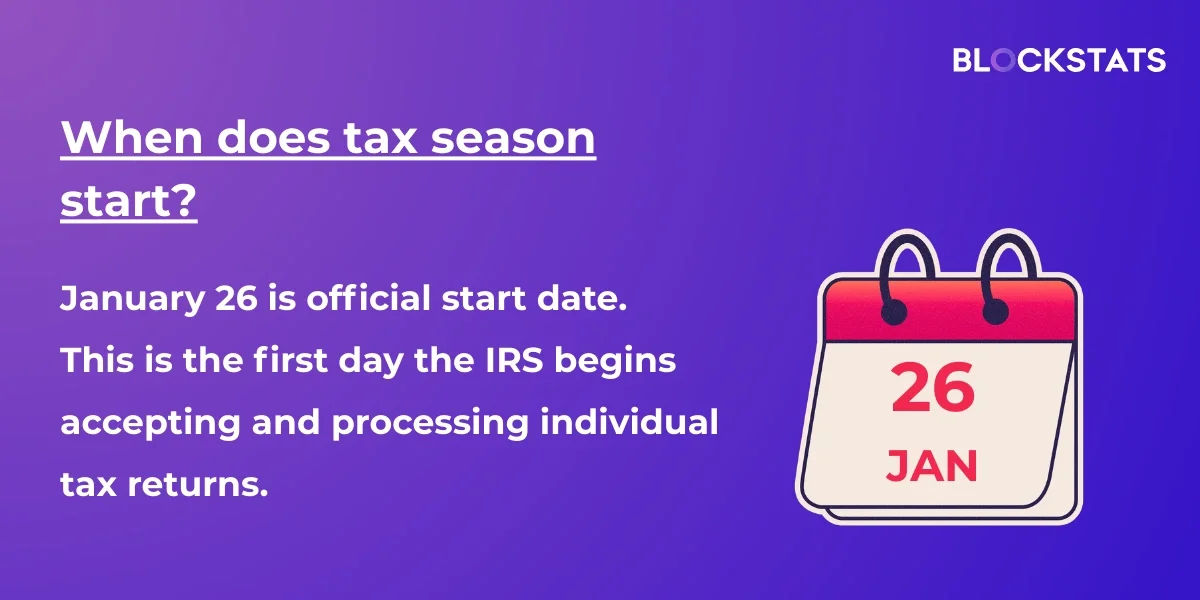
The IRS officially opened for the 2026 tax season on January 26, 2026. Preparation began earlier, with the IRS Free File program opening on January 9.
While you can submit data early, the IRS did not start processing returns until the 26th. For crypto investors, this period is best used to reconcile data in Blockstats to ensure your transaction history is accurate before the official filing window begins.
When are 2025 taxes due? (tax day 2026)
For the 2025 tax year, the deadline is Wednesday, April 15, 2026. This is a standard mid-April deadline.
Important Note: April 15 is also the deadline for:
-
IRA and HSA Contributions: The final day to make contributions for the 2025 tax year.
-
Estimated Tax Payments: If you have crypto gains not subject to withholding, your first quarterly estimated payment for 2026 is also due.
Is it too late to file past year taxes?
If you missed filing for 2022, 2023, or 2024, you can still submit those returns. However, the IRS has a three-year statute of limitations for claiming a refund. To get money back from 2022, you must file by April 15, 2026, or the refund is forfeited to the Treasury. To avoid these issues in the future, learning how to organize crypto taxes early is key.
When is tax season?
For most Americans, "tax season" refers to the period between early January and mid-April when the IRS accepts and processes federal income tax returns. For the 2026 tax season (reporting income earned in 2025), the window is officially defined by these key dates:
-
January 26, 2026: The official start date. This is the first day the IRS begins accepting and processing individual tax returns.
-
April 15, 2026: Tax Day. This is the deadline to file your return or request an extension, and the final day to pay any taxes owed to avoid penalties.
What are the major 2026 regulatory shifts crypto users must know
2026 is the year the IRS standardizes visibility into on-chain activity. Two changes are central to this shift.
The arrival of Form 1099-DA
In January 2026, crypto exchanges like Coinbase, Kraken, and Gemini began issuing Form 1099-DA (Digital Asset).
What is inside Form 1099-DA?
-
Gross Proceeds: The total value received when selling or swapping an asset.
-
Transaction Details: Dates of acquisition and sale, and the asset type.
-
Wallet Addresses: Often includes the blockchain address involved.
The "Cost Basis" Gap: For the 2025 tax year, brokers must report gross proceeds, but reporting cost basis is only mandatory for assets bought after January 1, 2026. This means your 1099-DA might show a $50,000 sale but leave the "Cost Basis" blank. Without understanding crypto cost basis tracking, the IRS may assume a $0 cost basis, resulting in a much higher tax bill.
The end of "Universal" cost basis tracking
In the past, investors often treated all held BTC as one pool. This is often influenced by whether you use FIFO or LIFO accounting. However, the IRS is tightening the rules.
The New Rule: As of January 1, 2025, the IRS requires Wallet-by-Wallet Tracking. You can only use the cost basis of assets held in the specific wallet or account where the sale occurred. This change makes manual spreadsheets nearly impossible to maintain.
How to file crypto taxes in 2026 with Blockstats
With new forms and per-wallet rules, filing requires a clear process.
Step 1: Gather your 1099s
Collect your Form 1099-DA from exchanges and IRS crypto tax forms like 1099-MISC for staking rewards.
Step 2: Connect wallets to Blockstats
Sync your exchange accounts and private wallets like MetaMask or Solana. Blockstats matches exchange data with on-chain activity to identify self-transfers, ensuring you don't pay tax on coins you simply moved between your own wallets.
Step 3: Reconcile data
Exchanges often list cost basis as "unknown" for assets moved from external wallets. Using Blockstats finds the original purchase price from your history and links it to the sale, so you only pay tax on the actual gain. This helps avoid common crypto tax mistakes.
Step 4: Generate your reports
Generate an IRS-ready Form 8949 and Schedule D. You can then easily file your crypto taxes with TurboTax or other major platforms. These reports provide a clear audit trail, which is essential for crypto tax audit preparation.
Check out: Free crypto profit calculator

Don't wait until April 15
With the IRS receiving automated 1099-DA reports, accuracy is vital. Failure to reconcile your data could lead to a crypto tax audit. You can also look for opportunities like crypto tax loss harvesting to reduce your liability before the deadline.
Use Blockstats to calculate your cryptocurrency taxes with your wallet history for an accurate and audit-ready filing.
Ready to get started?
✅ Generate crypto tax reports in minutes
✅ Get AI-Powered portfolio tracking✅ Find hidden deductions for tax savings
Frequently asked questions (FAQ)
When does tax season end in 2026?
The season ends at 11:59 PM local time on April 15, 2026. Residents of Maine or Massachusetts may have until April 17 due to local holidays.
How do I extend my 2025 taxes?
Submit Form 4868 by April 15 to get until October 15, 2026, to file. This extends the time to file your paperwork, but any taxes owed must still be paid by April 15 to avoid interest.
What happens if you miss the IRS deadline?
If you owe money and miss the deadline:
-
Failure-to-File: 5% of unpaid taxes per month.
-
Failure-to-Pay: 0.5% of unpaid taxes per month. If you are owed a refund, there is no penalty for filing late.
When can I expect my 2026 tax refund?
Most e-filed returns are processed within 21 days. Refunds for those claiming EITC or ACTC credits are generally held until mid-February.
Is crypto still taxed as property?
Yes. The IRS treats cryptocurrency as property. You should review the difference between taxable vs non-taxable crypto transactions to ensure you are reporting correctly.