How to File a Crypto Tax Extension with the IRS in 2026
April 15 is coming fast, and your crypto transaction history looks like a spreadsheet from a fever dream. Missing cost basis. Transfers flagged as sales. Five exchanges, three wallets, and one DeFi protocol you completely forgot about. You do not have to file a rushed, half-baked return. The IRS gives every taxpayer an option to request more time, and crypto investors use it all the time.
This guide walks you through exactly how to file a crypto tax extension in 2026, what it covers, what it does not, and how to avoid the penalties that catch people off guard.
Key highlights
US taxpayers can file IRS Form 4868 by April 15, 2026, to get an automatic 6-month extension to October 15, 2026
An extension gives you more time to file, not more time to pay. Any tax owed is still due by April 15
Filing late without an extension triggers a failure to file penalty of 5% per month, up to 25% of the unpaid tax
If you cannot pay in full, pay what you can. Partial payments reduce how much interest and penalties pile up
Most states follow the federal extension, but some require a separate state form check before assuming you are covered
What is a tax extension?
A tax extension is the standard IRS filing extension, which gives individual taxpayers an extra six months to submit their tax return. You do not need to explain why you need the extension. The IRS does not ask.
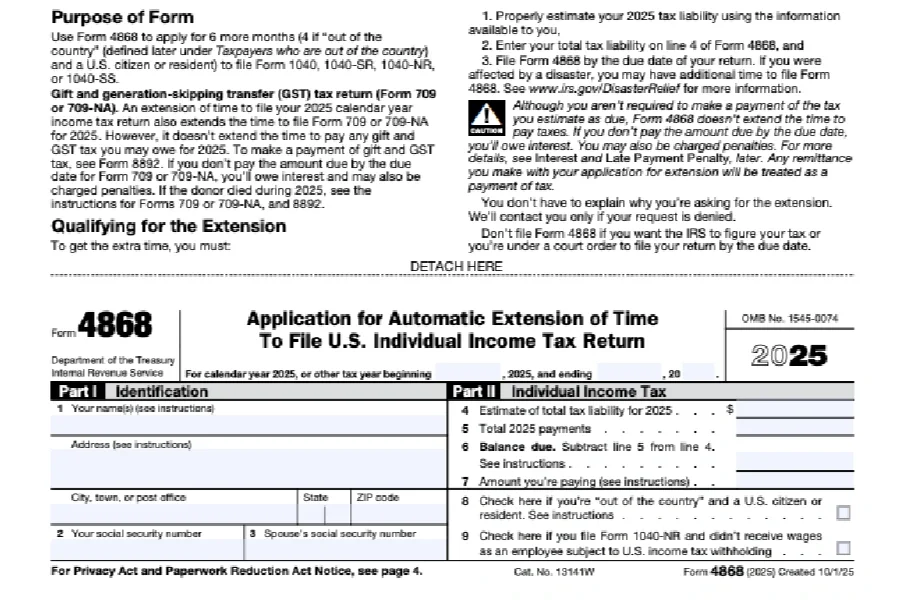
There is no special crypto extension form. The deadline for filing an extension is April 15. You use the same IRS Form 4868 that every individual taxpayer uses to request more time to file.
What the extension does not do is push your payment deadline. If you owe taxes, those are still due on April 15.
Read next: How to calculate crypto taxes in the US: step-by-step guide
How to file a crypto tax extension with the IRS
Here is the step-by-step process most crypto investors use.
Step 1: Get your crypto data estimate-ready
You do not need a clean, finished return to file an extension. You need a workable estimate.
Start with the biggest issues first. Flag transfers that got tagged as sales. Remove duplicate imports. Make sure your largest exchange accounts are all included.
You are not going for perfect here. You are going for a number you can defend.
Step 2: Estimate what you owe
Pull up last year's return as your starting point. From there, adjust for what changed this year: your wages, withholding, estimated tax payments, stock sales, and crypto activity.
For crypto specifically, aim to get three clean numbers:
-
Total short-term capital gains or losses
-
Total long-term capital gains or losses
-
Total crypto income, such as staking rewards, airdrops, mining, etc.
Those three figures give you enough to build a reasonable payment estimate. You can true everything up when you file the actual return in October.
Check out: Free crypto tax calculator →
Step 3: Submit the extension
Most people file Form 4868 through tax software or a CPA. You can also file it directly on the IRS website using the Free File program.
Another route: make a payment through the IRS online payment system and check the box indicating it is for an extension. In many cases, that eliminates the need to file a separate Form 4868.
If you prefer paper, you can mail the form, but electronic filing is faster and gives you instant confirmation.
Pay what you can by the deadline
Whatever your estimate shows, pay it by April 15.
If your records are still shaky and you are unsure whether your estimate is high or low, it is generally safer to overpay slightly. You will get the difference back as a refund when you file.
If you cannot pay the full amount, pay something anyway. A partial payment reduces the balance on which penalties and interest are calculated. You can also look into IRS payment plan options after filing.
Save your confirmation or mailing receipt. Then set a hard reminder for October 15.
When are IRS tax extensions due?
Form 4868 must be filed by the same date your tax return is due, which is April 15.
If you file on time, your new deadline to submit the full return is October 15, 2026. If either date falls on a weekend or federal holiday, the IRS moves it to the next business day.
One thing people often miss: interest on unpaid tax starts running from the original April 15 deadline, not from October 15. The extension shifts your filing deadline, not your payment clock.
Do I need to file a tax extension for my state taxes?
It depends on your state.
Many states automatically honor the federal extension for the filing deadline. But even when they do, most still expect you to pay any state tax owed by the original state deadline, not October 15.
Some states also require their own separate extension form. New York, for example, uses Form IT-370 for individual filers. California offers an automatic extension with no form required, but payment is still due by April 15.
|
State |
Filing extension |
Payment due |
|
Most states |
Accept federal extension |
Original state deadline |
|
California |
Automatic, no form needed |
April 15 |
|
New York |
Requires Form IT-370 |
Original state deadline |
|
States with no income tax |
Not applicable |
Not applicable |
If you are not sure, go directly to your state's revenue department website and check the current year's guidance. Do not assume you are covered just because you filed Form 4868.
Read next: What are the most crypto friendly states in the US in 2026
When should I file a tax extension for my cryptocurrency?
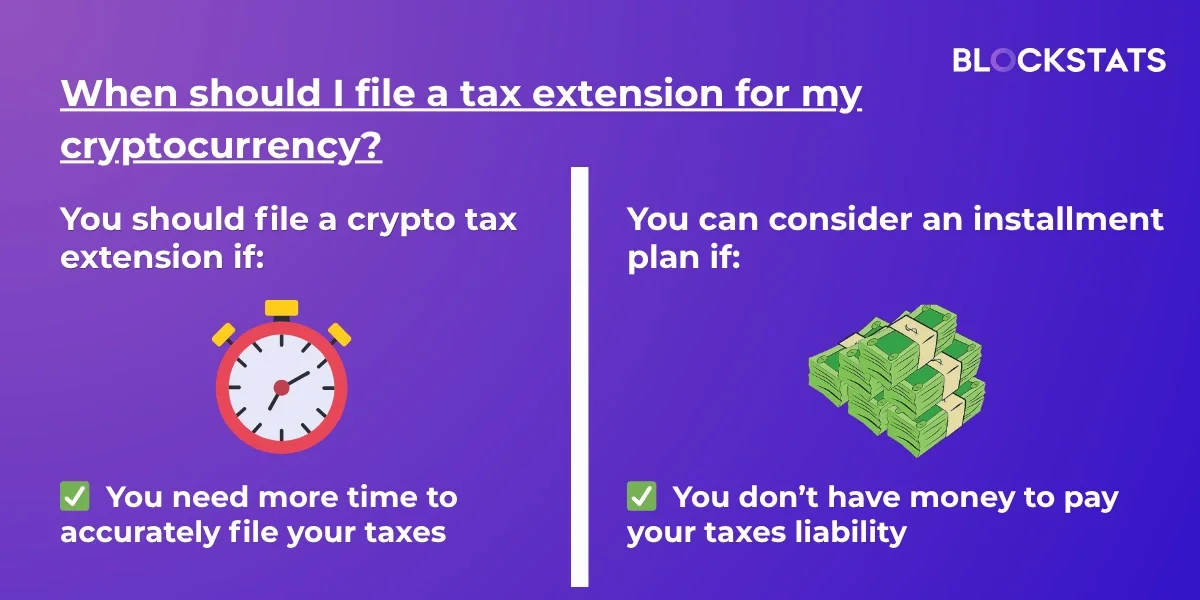
Filing an extension is not a red flag. It is a practical decision that keeps you out of the failure-to-file penalty lane.
The most common reasons crypto investors extend:
-
Activity spread across multiple wallets and exchanges that needs more time to reconcile properly
-
Missing cost basis for tokens bought on now-defunct platforms or moved between wallets
-
Waiting on tax documents or export files from exchanges
-
DeFi or NFT activity that requires careful classification before reporting
-
Simply not having enough time to file an accurate return by the deadline
An inaccurate return filed on time is often worse than a clean return filed on extension. Amended returns draw more attention, and errors can cost you more than the extension would have.
Read next: How is DeFi taxed in the USA?
Can I get an extension to file my crypto taxes?
Yes. Crypto investors are eligible for the same IRS filing extension as any other taxpayer.
File Form 4868 by April 15, and you get until October 15 to submit your complete return. The IRS does not ask for a reason, and approval is automatic.
One reminder: the extension covers filing, not payment. If you expect to owe taxes on crypto gains, staking income, or DeFi rewards, you still need to pay your best estimate by April 15 to avoid failure-to-pay penalties and interest.
Can I file a second tax extension?
In most cases, no. The IRS does not grant a second extension to individual US taxpayers.
There is one exception: US taxpayers living outside the country may be able to request an additional 4-month extension beyond October 15. The IRS guidance on Topic 304 covers the specifics for taxpayers abroad.
For everyone else, October 15 is the hard deadline. If you miss it, the failure-to-file penalties apply from that point forward.
Can I file an IRS tax extension with TurboTax?
Yes. TurboTax lets you file Form 4868 directly through the platform.
Go to the extension option within TurboTax and follow the prompts. You can file the federal extension and, in many cases, your state extension at the same time. Just make sure to do it before the April 15 deadline to avoid late filing penalties.
H&R Block and other major tax software platforms offer the same functionality.
What if I can't pay my taxes by the deadline?
Pay whatever you can by April 15 and then explore your options.
The IRS offers installment agreement plans that let you spread out the balance. You can apply online after filing your return.
A few things to understand about not paying:
-
The failure-to-pay penalty is 0.5% of the unpaid balance per month, up to 25%
-
Interest on unpaid tax compounds daily from the original due date
-
If your return is more than 60 days late, the minimum failure-to-file penalty in 2026 is $525 or 100% of the unpaid tax, whichever is less
Paying something, even a fraction of what you owe, reduces the base on which those penalties are calculated. Paying nothing is always the more expensive option.
Check out: Free crypto profit calculator →
What if I didn't report crypto in my return?
If you filed a return and left out crypto activity, do not ignore it.
You can file an amended return using IRS Form 1040-X to correct the omission. Coming forward voluntarily before the IRS contacts you is treated much more favorably than being caught after the fact.
Unreported crypto is increasingly hard to hide. Exchanges already share data with the IRS under KYC rules, and the IRS has used blockchain analytics tools to identify unreported transactions. Starting in 2026, exchanges are also required to issue Form 1099-DA, which will make on-chain activity even more visible to the IRS.
If you are unsure how to handle an amended return for crypto, a crypto-experienced CPA can help you navigate it without making the situation worse.
Read next: Can the IRS track my crypto transactions?
What can I do to avoid missing the tax deadline?
The best solution is preparation throughout the year, not scrambling in April.
A few habits that make a difference:
-
Track transactions as you go: Waiting until March to import a year's worth of data from six platforms is a recipe for chaos.
-
Label transfers immediately: A transfer between your own wallets is not a taxable sale. Misclassifying them early creates reconciliation headaches later.
-
Use crypto tax software: Use crypto tax software, like Blockstats. You can connect directly to your exchanges and wallets, automate the tracking and classification work, so you are not starting from scratch at tax time.
-
Know your deadlines: The IRS tax season for 2025 returns opened in January 2026. The earlier you start, the more options you have.
How to request an extension on the IRS website
Here is the direct path to filing Form 4868 online:
-
Go to the IRS Free File program
-
Select the Fillable Forms option and create your account
-
Click on "File Extension"
-
Enter your estimated tax liability, refer to the estimation steps earlier in this guide if you are unsure
-
Enter the amount you have already paid through withholding or estimated tax payments
-
Your balance due will be calculated automatically
-
Choose whether to submit a payment along with the form
-
Submit Form 4868 and save your confirmation
If October 15 falls on a weekend, note the adjusted deadline. The IRS moves it to the next business day.
How Blockstats simplifies crypto tax extensions
Estimating what you owe is the hardest part of filing an extension, especially if your activity spans multiple exchanges, wallets, and DeFi protocols.
Blockstats pulls it all into one place.
-
Connects to 100+ exchanges and wallets via API or CSV import
-
Automatically classifies transactions, including DeFi, staking, NFTs, and airdrops
-
Calculates your short-term gains, long-term gains, and crypto income so you have the three numbers you need for an accurate payment estimate
-
Generates IRS-ready reports, including Form 8949 and Schedule D
-
Identifies tax-loss harvesting opportunities before you file
-
Exports files compatible with TurboTax, TaxAct, H&R Block, and TaxSlayer
Whether you are filing by April 15 or using an extension, Blockstats gives you accurate numbers without the manual reconciliation work.
Stop guessing and start filing with confidence.
Get started with a Blockstats free account today and get your crypto taxes done right.
Crypto tax extension FAQs
When is the crypto tax deadline in the US?
The federal tax deadline for 2025 returns is April 15, 2026. If you file Form 4868 by that date, your extended filing deadline becomes October 15, 2026. Payment is still due April 15, regardless.
How long can I hold crypto without paying tax in the US?
There is no minimum holding period to avoid tax entirely. However, holding for more than one year before selling qualifies your gains for lower long-term capital gains rates, which are 0%, 15%, or 20% depending on your income.
Can I file an extension if I owe no tax?
Yes. You can file Form 4868 even if you do not expect to owe anything. There is no requirement to owe tax to request an extension.
What happens if I don't report my crypto transactions?
The IRS can assess back taxes, penalties, and interest. In serious cases, tax evasion can result in fines of up to $100,000 and up to 5 years in prison. Exchanges share data with the IRS, making unreported crypto increasingly difficult to conceal.
Can I file an IRS extension online?
Yes. You can file Form 4868 online through the IRS Free File program, through tax software like TurboTax or H&R Block, or through a CPA who e-files on your behalf.
How much does an IRS extension cost?
Filing Form 4868 itself is free. There is no IRS fee to request an extension. However, any taxes owed still accrue interest and potential failure-to-pay penalties from April 15 if not paid by the deadline.