Why Most Crypto Tax Software Fails at DeFi (And How Blockstats Fixes…
Last Updated: March 2026 — Reflects current IRS guidance, Revenue Ruling 2023-14, Form 8949 requirements, and 1099-DA reporting changes.
Key takeaways
Most crypto tax tools were designed for CEX trading and retrofitted for DeFi, creating systematic errors for DeFi & NFT users
LP reward misclassification, bridge transaction mislabeling, and wrong staking categorization are the most common failures
These errors directly impact IRS Form 8949, Schedule D, and Schedule 1 reporting, creating real audit exposure for US taxpayers
Blockstats uses protocol-level parsing and a 1-minute USD historical price conversion engine to fix each failure point automatically
You connected your wallets, imported your transactions, hit calculate, and got a number that made no sense.
Uniswap LP withdrawalsare showing as taxable sales. Staking rewards counted as capital gains. Arbitrum bridge flagged as a disposal. Airdrop double-counted. Sound familiar?
These are a design flaw. Most crypto tax software was built for centralized exchanges, clean CSV files, and simple buy/sell pairs. DeFi doesn't work that way. When you force CEX-first tools onto smart contract activity, they break in specific, costly ways. Here's exactly where they fail, and how Blockstats fixes each one.
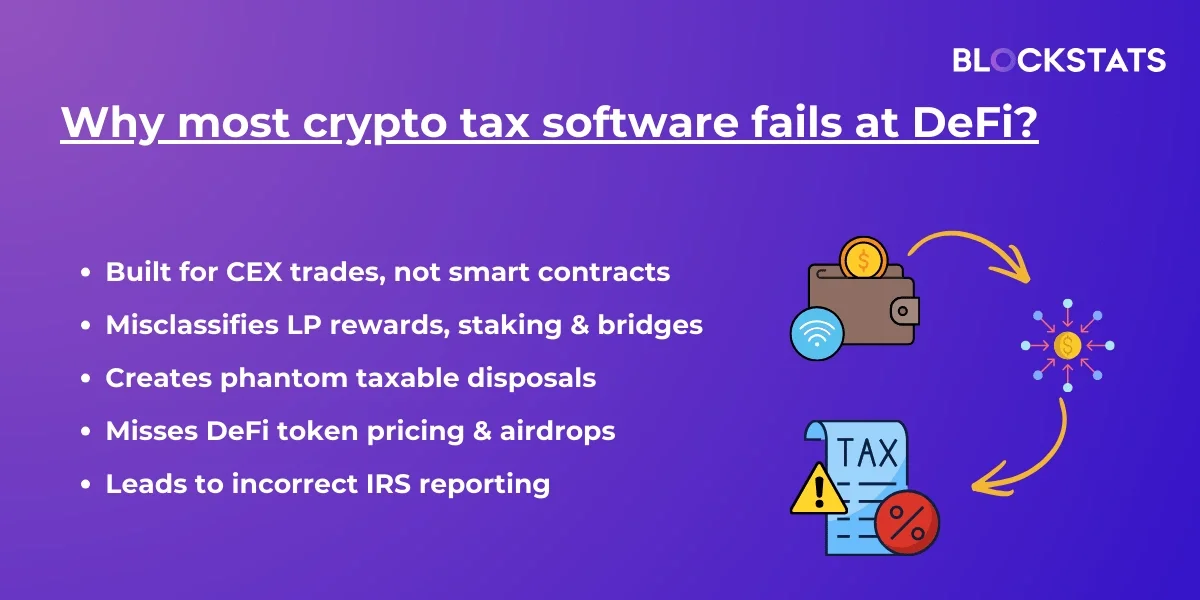
The breakdown: Every failure, every fix
|
The Problems |
How Blockstats fixes it |
|
Misclassifies smart contract interactions |
Protocol-level parsing, no phantom disposals |
|
Staking rewards filed as capital gains |
Auto-classifies as ordinary income at receipt |
|
LP rewards and fees miscategorized |
Full LP lifecycle tracking from deposit to withdrawal |
|
Bridge transactions trigger phantom gains |
Cross-chain cost basis continuity maintained |
|
Wrong token pricing for DeFi assets |
1-minute USD historical price engine, 15,000+ tokens |
|
Airdrops double-counted |
Single income entry, correct cost basis established |
|
Thousands of manual fixes required |
End-to-end automation across supported protocols |
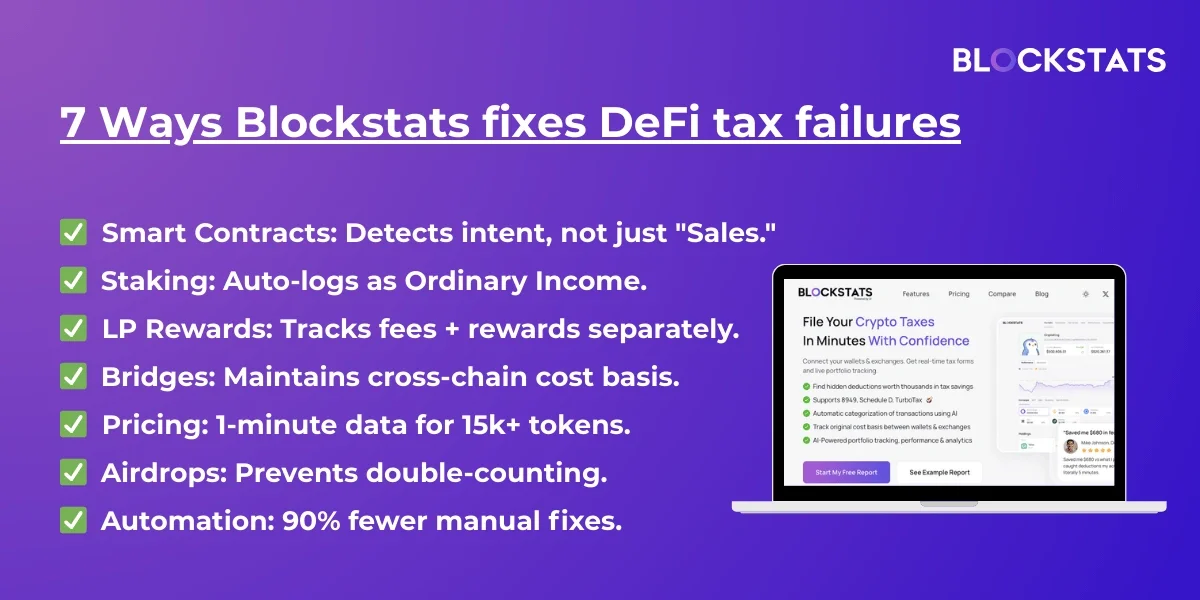
7 ways crypto tax software fails at DeFi (and how Blockstats fixes each one)
1. Misclassifying smart contract interactions
Generic crypto tax tools categorize every wallet interaction as a buy, sell, or transfer. DeFi smart contracts don't fit those boxes. Swapping ETH for WETH gets treated as a taxable disposal. A token approval logs as a transaction. Depositing into Aave reads as a sale. The tool sees token movement and assumes the worst.
For high-volume traders with dozens of protocol interactions daily, this creates hundreds of phantom taxable events, inflating your IRS Form 8949 beyond recognition.
How Blockstats fixes it:
Blockstats maintains a protocol-intent database. Aave deposits are recognized as lending positions, not sales. ETH-to-WETH wrapping is flagged as a non-taxable migration. Token approvals are excluded. The result is a Form 8949 that reflects what actually happened.
2. Getting staking rewards wrong
Under IRS guidance, US taxpayers' the staking rewards are taxed as ordinary income, not lower long-term capital gains. Incorrectly classifying these rewards as capital gains significantly understates tax liability.
Different staking mechanisms, e.g., continuous Lido stETH, epoch-based Ethereum validation, and manual governance token claiming require varied tax treatment, which many tools fail to accurately apply.
How Blockstats fixes it:
Blockstats classifies staking rewards as ordinary income at the moment you gain control, based on each protocol's specific distribution mechanism. It separately tracks the cost basis of received tokens for accurate short-term vs long-term capital gains when you eventually sell, no blanket rules, no manual tagging.
3. LP reward misclassification
Liquidity pools offer three revenue streams, such as trading fees, liquidity mining, and price appreciation. Most tools incorrectly categorize these, causing tax and accounting issues.
For example, invisible auto-compounding Uniswap V2 fees and miscategorized Curve rewards complicate cost basis reconstruction for CPAs and accountants.
How Blockstats fixes it:
Blockstats tracks the full LP lifecycle, deposit, fee accrual, reward distribution, and withdrawal, knowing that Uniswap V2 fees compound automatically while Curve gauge rewards require claiming. Each revenue stream gets correct treatment. Schedule D and Schedule 1 entries come out clean.
4. Bridge transactions mislabeling
Bridging USDC from Ethereum to Arbitrum is often incorrectly logged as a disposal on Ethereum and a new purchase on Arbitrum. This mislabeling is inaccurate as it's the same asset on a different chain.
This error creates phantom capital gains on the Ethereum side and resets the cost basis on the Arbitrum side. Cumulatively, this inflates apparent returns over multiple bridge transactions.
How Blockstats fixes it:
Blockstats recognizes cross-chain bridge patterns and preserves cost basis continuity. Your Arbitrum USDC retains the original Ethereum purchase price.
5. Historical USD price gaps for DeFi tokens
Cost basis requires knowing the USD value of a token at the exact moment. For newly launched governance tokens, illiquid LP receipts, or obscure protocol rewards, most crypto tax softwares have no data.
A cost basis of zero means the entire future sale value becomes a taxable gain. For US taxpayers using FIFO, LIFO, or HIFO, price accuracy at the transaction level is the foundation of everything.
How Blockstats fixes it:
Blockstats' historical price engine covers 15,000+ tokens with 1-minute interval data across both CEXs and DeFi pools. Even illiquid tokens get accurate USD valuations at the exact timestamp. This makes cost basis calculations defensible to the IRS.
6. Airdrop and governance reward miscounting
Airdrops are ordinary income under IRS guidance, taxable at fair market value when received. But most crypto tax software either misses them entirely or counts them twice, once as income, once as a portfolio addition. Sometimes even fail to establish a proper cost basis for future sale. Governance token distributions face the same problem.
Double-counting an airdrop as both income and a new purchase falsely overstates taxable income and skews the cost basis for future token sales.
How Blockstats fixes it:
Blockstats automatically tracks and classifies airdrops and governance rewards as ordinary income upon receipt, using accurate USD pricing. It establishes the correct cost basis for each token. Each token is recorded once as income, then tracked for capital gains when sold. This eliminates double-counting, missing entries, and manual work.
7. Forcing manual fixes at scale
You import 8,000 transactions, and 2,000 come back as "unrecognized" or flagged for manual review. You're not sure if your corrections are internally consistent. Your CPA charges extra hours to reconcile what the software missed.
This is the real cost of using a tool that doesn't understand DeFi. Not just inaccuracy, wasted time, and inconsistent application of cost basis methods.
How Blockstats fixes it:
Blockstats minimizes manual tagging through automated protocol classification. Only novel or ambiguous transactions are flagged.
This makes it particularly useful for:
-
High-volume traders
-
Multi-chain investors
-
CPAs and accounting firms
Blockstats vs generic crypto tax software
|
Transaction Type |
Blockstats |
Generic Tool |
|
ETH to WETH wrapping |
Non-taxable migration |
Taxable disposal |
|
Aave deposit |
Lending position, no disposal |
Logged as sale |
|
Uniswap V2 fee accrual |
Tracked, categorized as income |
Invisible |
|
Arbitrum bridge |
Cost basis maintained |
Phantom capital gain |
|
Staking rewards |
Ordinary income (correct) |
Capital gains (wrong) |
|
Airdrop received |
Income at receipt, correct basis |
Often double-counted |
|
Obscure DeFi token pricing |
1-min USD historical price |
Zero or daily average |
Why does this matter more in 2026?
Beginning in 2026, Form 1099-DA expands broker reporting requirements. Increased exchange reporting means:
-
Greater IRS cross-verification
-
Higher scrutiny on the mismatched cost basis
-
Reduced tolerance for inconsistent classification
Inaccurate bridge reporting, staking misclassification, and missing income entries may become more visible under expanded reporting standards.
Tools that accurately track cost basis across wallets and chains will become increasingly important.
Who needs DeFi-aware crypto tax software in 2026??
- High-volume traders: Frequent DeFi swaps multiply small classification errors. Misreported LP interactions can inflate Form 8949 and distort gains. Traders using FIFO, LIFO, or HIFO need accurate cost basis tracking across thousands of smart contract transactions.
- Yield farmers and LPs: LPs earn layered income from fees and rewards. Many tools fail to separate ordinary income from capital gains properly, leading to manual fixes and inconsistent Schedule D and Schedule 1 reporting.
- Multi-chain US traders: Bridging across Ethereum, Arbitrum, Base, or Solana can create phantom gains if cost basis continuity isn’t preserved. With 1099-DA reporting expanding in 2026, accurate multi-chain tracking is increasingly critical.
- CPAs and accounting firms: DeFi clients often generate incomplete or misclassified exports in CEX-first tools. Manual reconciliation increases preparation time and audit exposure. Protocol-aware software reduces errors and improves reporting consistency.
Need something beyond standard service? For crypto tax professionals and expert review, Blockstats offers a Full Service Plan, which includes tax planning, audit support, and multi-jurisdiction filing
Conclusion
DeFi introduces structural complexity that many crypto tax tools were not originally designed to handle. Misclassification can lead to inflated taxable gains, underreported income and increased audit risk. As regulatory reporting expands in 2026, accuracy becomes more important than ever.
Blockstats approaches DeFi tax reporting at the protocol level rather than treating all token movement as buy and sell activity. For traders seeking both tax compliance and portfolio analytics in one platform, it provides a comprehensive solution.
Start your free report at:
Blockstats today!
Frequently asked questions
Why do most crypto tax tools fail at DeFi?
Most tools were built for centralized exchange trading and retrofitted for DeFi. They lack protocol-level understanding, causing LP reward misclassification, bridge transaction mislabeling, and staking income errors that directly affect IRS Form 8949 and Schedule D accuracy.
What makes Blockstats different from other crypto tax software?
Blockstats differentiates itself as one-stop-shop for both tax compliance and performance analytics. Blockstats is a comprehensive crypto tax and portfolio tracker with AI-powered integration across 500+ sources. It excels in tracking DeFi and liquidity pools, providing automated, IRS-compliant tax forms and detailed performance analytics for traders.
Can Blockstats fix my messy DeFi transaction history?
Yes. Connect your wallets, and Blockstats automatically re-parses your full transaction history using protocol-aware logic. Most users find their previously unrecognized or miscategorized DeFi transactions resolved automatically without manual intervention.
Is DeFi income taxed differently from crypto trading gains?
Yes. Staking rewards and airdrop income are ordinary income under current IRS guidance, taxed at your marginal rate. Capital gains from selling DeFi assets follow short-term vs long-term rules depending on the holding period. Most generic tools conflate these, creating inaccurate returns.
What happens if my crypto tax software miscategorizes DeFi transactions?
Miscategorization creates inaccurate Form 8949 entries and Schedule D totals. This can mean overpaying taxes on phantom gains, underpaying on misclassified income, or filing inconsistently, all of which create audit exposure as the IRS expands its 1099-DA cross-referencing program.