Is Robinhood Safe To Use In 2026?
Robinhood has over 27 million users and $225 billion in assets under custody as of 2026. But if you are an investor, you might be asking, Is Robinhood Safe to use for crypto and stock investments?
If you are storing stocks, ETFs, or crypto on Robinhood, you need to know exactly what is protected, what is not, and what risks lie. This guide breaks it all down to see if Robinhood is right for you.
Key takeaways
Quick verdict: Robinhood is relatively safe for mainstream investing, particularly for beginners buying stocks and ETFs. For crypto, the picture is more complicated, but largely safe for small and medium investments.
Robinhood is a registered broker-dealer regulated by the SEC and FINRA. It is an SIPC member, which means eligible securities and cash are protected up to $500,000 if the brokerage fails.
Crypto on Robinhood is not covered by SIPC or FDIC. You do not hold private keys unless you use the separate Robinhood Wallet app.
FDIC coverage only applies to uninvested cash after it is swept into partner banks, not to stocks, ETFs, or crypto.
What is Robinhood?
Robinhood is a US-based brokerage platform that lets you trade stocks, ETFs, options, and around 40 cryptocurrencies. It launched in 2014 and became widely known for removing trading commissions, which was a big deal at the time.
Today, it offers IRAs with contribution matching, a cash management account, a credit card, and a separate crypto wallet app. It is publicly traded and regulated in the US.
It is built for simplicity and speed. That is its biggest strength and, depending on your needs, also its biggest limitation.
Are Robinhood deposits and holdings insured?
Different assets on Robinhood receive different types of protection, and crypto is treated very differently from stocks or cash deposits.
|
Asset type |
SIPC protected? |
FDIC insured? |
What protection actually applies |
|
Crypto |
No |
No |
Crypto assets are not protected under SIPC or FDIC insurance programs |
|
Stocks and ETFs |
Yes |
No |
Eligible securities may be replaced if the brokerage fails, but investment losses are not covered |
|
Options contracts |
Typically yes |
No |
Protection applies to brokerage custody issues, not losses from trading activity |
|
Uninvested brokerage cash |
Yes, within SIPC cash limits |
No |
Covers missing customer cash during a brokerage liquidation process |
|
Cash held through bank sweep programs |
No |
Usually yes, through partner banks |
May qualify for FDIC insurance if deposits are held at participating banks |
Is Robinhood a safe platform for investors?
The short answer is yes, Robinhood is safe for investments. Robinhood is a legitimate, regulated brokerage. But "safe" means different things depending on what you are holding.
Is Robinhood safe for crypto trading and investments?
This is where most people get confused. Robinhood supports around 40 cryptocurrencies, like Bitcoin, Ethereum, Shiba Inu, and Aave. But your crypto holdings on the main Robinhood app are held in a custodial account. That means Robinhood controls the private keys, not you.
Your crypto is also not covered by SIPC or FDIC. If Robinhood faced a major hack or insolvency event, your crypto recovery would not follow the same process as your stock recovery.
For small crypto positions or casual exposure, this is manageable. For large crypto portfolios, it is a meaningful risk.
Read next: Beginner’s guide - How to read crypto chart
Is Robinhood safe for stocks and ETFs?
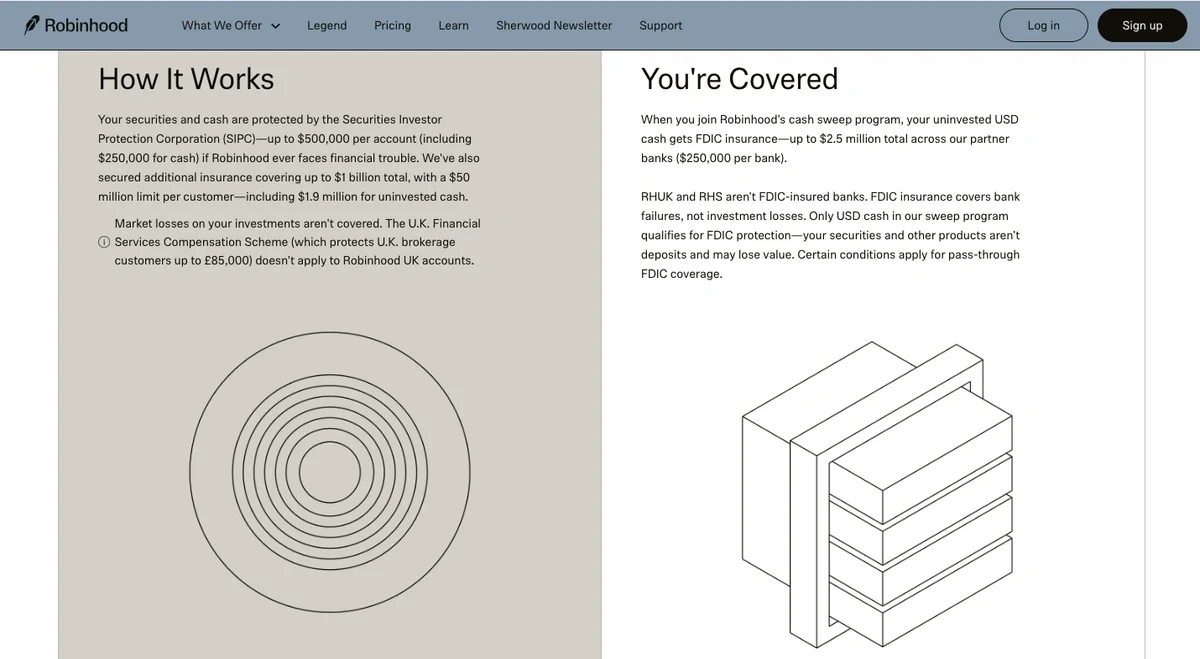
Yes, this is where Robinhood is on solid ground. Stocks and ETFs held on Robinhood are covered by SIPC up to $500,000, including $250,000 for cash claims. Robinhood also offers additional coverage through Lloyd's of London, which adds $1.9 million in cash and $50 million in securities protection per customer beyond the SIPC limit.
This puts it on par with traditional brokerages like Fidelity or Charles Schwab for stock investors.
So, is your money actually safe with Robinhood?
For stocks and ETFs, yes. For uninvested cash swept into partner banks, yes, up to FDIC limits.
For crypto, it depends on how much you hold and how much custody risk you are comfortable with.
The key distinction is this. SIPC and FDIC protect you if Robinhood fails. They do not protect you from your investments losing value.
How Robinhood protects user accounts and funds
SEC and FINRA regulation
Robinhood Financial is a registered broker-dealer with the SEC and a FINRA member. This means it has to follow the same rules as every other licensed US brokerage. It must maintain capital requirements, handle customer complaints through proper channels, and submit to regulatory audits.
SIPC insurance limit you need to know
This table shows the coverage limits and protections Robinhood users should understand.
|
Coverage type |
Common limit |
What it covers |
What it does not cover |
|
SIPC (standard) |
$500,000 total, including $250,000 for cash |
Eligible securities and cash if a brokerage fails |
Market losses, bad trades, crypto price drops |
|
Robinhood “excess of SIPC” policy through Lloyd’s of London |
Up to $50,000,000 for securities, including up to $1,900,000 for cash |
Additional protection for accounts exceeding standard SIPC limits |
Market losses, crypto assets, and most scam-related losses |
FDIC cash sweep protection
Uninvested cash in your Robinhood account can be swept into a network of FDIC-insured partner banks. Once it is there, it qualifies for FDIC protection up to $2.5 million, depending on the banks involved and your total deposits at each bank.
This does not apply to crypto or securities. It only applies to cash sitting uninvested.
Robinhood security features
Robinhood uses standard-grade security across the platform, including encryption of sensitive data, biometric login on supported devices, login alerts, device verification and session controls, and in-app flagging for suspicious activity.
Account monitoring and two-factor authentication
Robinhood supports both SMS-based and app-based 2FA. App-based 2FA, such as Google Authenticator, is harder to compromise than SMS.
The difference between brokerage failure and market losses
This distinction matters. If Robinhood collapsed tomorrow and your account showed 15 shares of an ETF but only 12 could be located, SIPC would work to recover the missing 3 shares up to its coverage limits.
If those same shares dropped 30% in value because the market fell, the SIPC would do nothing. That is a normal investment loss, and no insurance covers it.
Is Robinhood safe for crypto?
Robinhood Crypto deserves its own section because the risks are meaningfully different from stocks.

Do you actually own crypto on Robinhood?
On the main Robinhood app, no. You hold a position in crypto, but Robinhood holds the actual coins. This is called custodial ownership. You see the balance, but you do not control the wallet.
The Robinhood Wallet app is a separate product that gives you self-custody with private key control. It supports Ethereum, Base, and Arbitrum networks. But this is not the default experience most users have.
Read next: Top AI crypto coins and projects to watch for 2026
Custodial wallets vs self-custody
When a platform holds your crypto for you, that is a custodial wallet. When you hold your own private keys, that is self-custody.
The crypto community phrase "not your keys, not your crypto" exists for a reason. If a custodial platform is hacked, goes bankrupt, or freezes withdrawals, you may not be able to access your funds.
Self-custody options like hardware wallets give you full control but come with their own responsibility. If you lose your private key, your crypto is gone permanently.
Are crypto holdings insured?
No. SIPC does not cover crypto. FDIC does not cover crypto. Robinhood does hold a portion of user crypto in cold storage to reduce hack exposure, but the exact percentage is not publicly disclosed.
Can Robinhood freeze crypto withdrawals?
Yes. Robinhood can restrict withdrawals if it detects unusual login activity, identity verification issues, unsettled funds, or during periods of extreme market volatility. This has happened before and is written into their terms of service. It is also common across most centralized exchanges.
Users who want more control over their assets may prefer transferring Bitcoin from Robinhood to an external wallet for self-custody.
Risks of keeping large crypto balances on Robinhood
The platform is fine for small, medium, or casual crypto holding. But if you are holding a significant amount of Bitcoin, Ethereum, or other assets long term, the custody risk and a lack of insurance. It is a less suitable choice compared to a dedicated crypto exchange with self-custody options or a hardware wallet like Ledger.
Has Robinhood ever been hacked or fined?
Yes, in November 2021, an unauthorized party gained access to Robinhood's customer support systems through a social engineering attack. Email addresses for approximately 5 million users were exposed. No financial losses were reported directly, but the incident damaged trust significantly.
SEC fines and regulatory scrutiny
Robinhood has faced multiple regulatory actions over the years.
-
In 2020, the SEC fined Robinhood $65 million over payment for order flow disclosures and best execution failures.
-
In 2021, FINRA fined the company $70 million for supervision failures, outages, and misleading customers.
-
In 2022, New York's financial regulator fined Robinhood Crypto $30 million for anti-money laundering and cybersecurity failures.
-
In January 2025, the SEC settled with Robinhood for $45 million tied to information security failures. Later in 2025, FINRA added a $29.75 million settlement for additional compliance violations.
These are serious actions. They are also not unusual for large financial platforms. What matters is what changed afterward.
What Robinhood improved afterward
After the 2021 breach, Robinhood implemented additional employee security training and tightened access controls across its customer support systems.
After the 2022 and 2025 regulatory actions, the company strengthened its AML programs, cybersecurity infrastructure, and compliance procedures.
What are the risks of using Robinhood?
Robinhood is safe for simple crypto portfolios, but it doesn’t protect you from all risks like stocks. The dangers are market swings, leverage, and scams, which are common across centralized exchanges.
Market volatility: Stocks, ETFs, options, and crypto can all lose value. No insurance covers market-driven losses.
Options trading risks: Robinhood makes options trading accessible to beginners, which is convenient but also comes with risk if you do not fully understand how options work.
Platform outages during volatility: Robinhood has experienced outages during high-volatility trading periods in the past. If you cannot access your account when the market is moving fast, that can be costly.
Payment for order flow concerns: Robinhood routes customer trades through third-party market makers like Citadel Securities and Virtu and earns revenue from this process. Critics argue this can lead to slightly worse trade execution quality. For long-term investors, the impact is minimal. For active day traders, it is worth knowing.
Phishing and account takeover scams: The most common way Robinhood accounts get compromised is through phishing emails, fake login pages, or stolen passwords. Using a unique password and enabling app-based 2FA dramatically reduces this risk.
SIM swap attacks: A SIM swap is when a scammer convinces your mobile carrier to transfer your phone number to a SIM card they control. Once they have your number, they can intercept SMS-based 2FA codes. The fix is simple. Switch from SMS 2FA to an authenticator app.
Gamification criticism: Robinhood has been criticized for making trading feel like a game, particularly with features like virtual confetti animations when trades are completed. Critics argue this encourages impulsive decisions, especially with options.
Warren Buffett said Robinhood is promoting casino behavior. Robinhood has "become a very significant part of the casino aspect, the casino group, that has joined into the stock market in the last year or year and a half.”
Customer support and withdrawals: Most Robinhood support happens through the app. Phone support is available for some issues but not all, and hours are limited. During urgent account problems, getting fast help can be difficult. This is one of the most consistently cited complaints from users.
If you’re concerned about accessing your funds quickly, here’s a detailed guide on how to withdraw money from Robinhood to your bank safely.
What happened during the GameStop controversy?
In January 2021, retail investors coordinating on Reddit's WallStreetBets forum began buying GameStop stock aggressively. The goal was to trigger a short squeeze against large hedge funds that had bet the stock would fall. The price went from under $20 to a peak of $483.
At the height of the frenzy, Robinhood restricted buying on GameStop and several other volatile stocks, including AMC and BlackBerry. Users could only sell, not buy. The price collapsed shortly after.
Robinhood explained that the extreme trading volume required it to post significantly more collateral with its clearinghouses, and restricting trades was the only way to meet those requirements quickly.
The backlash was immediate. Users, politicians, and commentators accused Robinhood of protecting hedge funds over retail investors. Multiple lawsuits followed, and Robinhood's CEO faced congressional hearings where he defended the decision as a regulatory and liquidity necessity, not a deliberate choice to harm retail traders.
Afterward, Robinhood raised several billion dollars in emergency capital to improve its financial resilience and overhauled its risk management and transparency procedures. The company stated these changes would allow it to handle extreme volatility without needing to restrict trading in the future.
Who should use Robinhood?
Robinhood is best suited for beginner to intermediate investors. It is ideal for those investors who are looking to consolidate, as it offers crypto trading, retirement accounts, and banking features like a high-yield cash account
-
Beginners: Robinhood is genuinely well-designed for people who are new to investing. No account minimum, no trading commissions, fractional shares, and a clean mobile interface make it easy to start with as little as $10.
-
Crypto investors: For casual crypto exposure, Robinhood is fine. For serious crypto investing with self-custody, staking, DeFi access, or a wide range of coins, dedicated exchanges are a stronger option.
-
Casual investors: If you buy a few ETFs or stocks, hold them long term, and check your account occasionally, Robinhood covers everything you need without unnecessary complexity.
-
Active traders: Robinhood works for basic active trading, but it lacks advanced charting tools, in-depth research, and screeners that serious day traders typically need.
-
Long-term retirement investors: Robinhood offers traditional and Roth IRAs with a 1% contribution match (3% for Gold members). For passive long-term investors, this is a genuinely competitive feature.
Read next: Robinhood alternatives for options trading
Is Robinhood safer than Coinbase, Kraken, or Binance?
So, which platform is safer for crypto users? If you are a crypto trader, you want the best.
|
Feature |
Robinhood |
Coinbase |
Kraken |
Binance |
|
Crypto withdrawals |
Limited on main app |
Yes, full |
Yes, full |
Yes, full |
|
Self-custody friendly |
No (main app) |
Yes (Coinbase Wallet) |
Yes |
Yes |
|
Beginner-friendly |
Yes |
Yes |
Moderate |
Moderate |
|
Advanced trading |
Limited |
Moderate |
Yes |
Yes |
|
Regulatory trust (US) |
High |
High |
High |
Lower |
|
Best for |
Beginners, stock + casual crypto |
Crypto beginners to intermediate |
Intermediate to advanced crypto |
Advanced, high-volume crypto |
Each platform has different strengths. Robinhood leads in simplicity and stock integration. Coinbase and Kraken offer better crypto self-custody and more coin options. Binance has the widest crypto selection but lower US regulatory certainty.
For someone who wants one app for stocks and small crypto positions, Robinhood is reasonable. For someone primarily focused on crypto, a dedicated exchange gives you more control and flexibility.
Read next: Coinbase vs Gemini, which is better for crypto trading
How to use Robinhood more safely
Here are a few tips to keep your Robinhood safe and secure for crypto and other investments.
Use app-based 2FA instead of SMS: SMS-based 2FA can be bypassed through SIM swap attacks. An authenticator app like Google Authenticator or Authy generates codes locally on your device and is far more secure.
Watch for phishing scams and fake support: Robinhood never requests passwords or 2FA codes via phone, text, or email. Treat any such request as a scam. Watch for red flags like social media impersonators, lookalike domains, fake investment groups, or urgent alerts about account compromises designed to provoke impulsive actions.
Avoid storing large crypto balances: If you are holding a meaningful amount of crypto long term, Robinhood's custodial setup is not ideal. Consider moving larger holdings to a self-custody wallet, MetaMask, or a hardware wallet for better security and control.
Use strong passwords and device security: Use a unique password that you do not use anywhere else. A password manager makes this easy. Enable biometric login if your device supports it.
Monitor withdrawal activity: Set up notifications for any withdrawal requests, account changes, or new device logins. If something looks wrong, change your password immediately and contact Robinhood support through the official app or website.
Robinhood review: Pros and Cons of Robinhood
Robinhood excels at accessibility. It removes the barriers that kept many people out of investing.
The trade-off is that it is not built for advanced use cases, and its crypto offering lags behind dedicated exchanges on almost every measure that matters to serious crypto investors.
|
Pros |
Cons |
|
$0 Commission on trading |
Limited crypto selection (around 40 coins) |
|
No account minimum |
No self-custody on main app |
|
SIPC and excess SIPC coverage |
Crypto not insured by SIPC or FDIC |
|
FDIC cash sweep protection |
Customer support can be slow |
|
Beginner-friendly interface |
Limited research and charting tools |
|
IRA with contribution match |
Past regulatory fines and security incidents |
|
Fractional shares |
Gamification concerns for impulsive traders |
|
24-hour market access |
Payment for order flow affects execution quality |
Does Robinhood report to the IRS?
Yes. Robinhood reports taxable activity to the IRS and provides year-end tax forms to customers. For stock trades, you will receive a 1099-B. For crypto, reporting is rolling out in phases.
For sales and exchanges on or after January 1, 2025, brokers are generally required to report gross proceeds on Form 1099-DA. Cost basis reporting for covered digital assets phases in for sales starting January 1, 2026, which affects the tax returns you will file in early 2027.
What about Robinhood customer support?
Most Robinhood support runs through the in-app chat. There is 24/7 chat support for general queries, but phone support is only available for certain issues and during limited business hours.
In urgent situations like a suspected account breach or a failed withdrawal, a slow support response can be genuinely problematic. Users consistently flag this in reviews.
Final verdict: Is Robinhood safe in 2026?
Yes, Robinhood is safe for most investors, including crypto, stocks, and ETFs. It's a legitimate, regulated brokerage with real insurance protections in place, like SIPC coverage and excess Lloyd's.
For crypto, Robinhood is acceptable for small or casual crypto holdings. Limited coin selection and lack of insurance for crypto holdings make it a weaker choice for serious crypto investors.
While Robinhood is safe and regulated, it doesn’t mean risk-free. Market volatility, impulsive trades, or the platform's limited range of securities are challenges for investors.
Track your Robinhood taxes accurately with Blockstats
Selling stock or realizing crypto gains on Robinhood is a taxable event, and this needs to be reported accurately.
Blockstats crypto calculator helps you calculate gains and losses. Connect your Robinhood account on Blockstats to track your crypto and calculate your crypto tax.
FAQs about Robinhood safety
Can Robinhood be trusted?
Yes, Robinhood is trusted by most investors. It is a regulated broker-dealer and SIPC member with real oversight from the SEC and FINRA. It has faced fines and controversies in the past, but it operates legally and maintains standard investor protections for stocks and eligible cash.
Is Robinhood safer than Coinbase?
Both are US-regulated and reputable. Robinhood is better for combining stocks and casual crypto in one app. Coinbase offers more crypto options, more coins to trade, and self-custody through Coinbase Wallet. Neither is universally safer; it depends on your use case.
Is Robinhood safe for beginners?
Yes. No account minimum, commission-free trading, and a simple interface make it one of the most accessible platforms for new investors. Just be aware that easy access to options trading carries real risk if you do not fully understand how leverage works.
Is Robinhood crypto insured?
No, crypto holdings on Robinhood are not covered by SIPC or FDIC. A portion is kept in cold storage, but the exact amount is not disclosed. If Robinhood faced a major insolvency or hack, crypto recovery would not follow the same SIPC process as stocks.
What happens if Robinhood shuts down?
Your stock and ETF holdings would not disappear. SIPC would oversee the process of returning eligible securities and cash up to its coverage limits. For crypto, the process is less clear since it falls outside SIPC protection.
Can Robinhood freeze withdrawals or restrict accounts?
Yes, Robinhood can restrict trading or withdrawals for reasons including unusual login activity, identity verification requirements, unsettled funds, margin issues, or extreme market volatility. This is standard practice at most brokerages, but it has frustrated users in the past, particularly during the GameStop situation.
Do you own your crypto on Robinhood?
On the main Robinhood app, no. Robinhood holds the private keys, which means it has custody of your coins. The separate Robinhood Wallet app does offer self-custody on Ethereum, Base, and Arbitrum networks, but that is a different product from the main brokerage.
Is Robinhood regulated in the US?
Yes. Robinhood Financial is registered with the SEC and is a FINRA member broker-dealer. Robinhood Crypto operates under FinCEN registration and state-level money transmission licenses. It is subject to US financial regulations, though it has faced enforcement actions from both the SEC and FINRA over compliance failures.