What Is Coinbase Card?

Coinbase Card lets you spend crypto like cash at any Visa-accepted merchant, converting your digital assets to fiat the moment you pay. But before you apply, here is everything you should know, from how it works to the tax implications most guides skip.
Key takeaways
Coinbase Card is a Visa prepaid debit card issued by Pathward, N.A. that lets you spend USD, USDC, or supported crypto anywhere Visa is accepted.
US users can earn up to 4% back in crypto rewards on purchases, with rotating monthly options and no staking requirement.
There is no annual fee, no foreign transaction fee, and no Coinbase fee for card spending or ATM withdrawals.
Spending non-stablecoin crypto triggers a taxable disposal in the US, which means gains or losses to report.
The card is available across 49 US states (all except Hawaii), the UK, and most EEA countries.
Coinbase Card overview
|
Detail |
Info |
|
Card type |
Visa prepaid debit |
|
Issuer |
Pathward, N.A. |
|
Program partner |
Marqeta |
|
Availability |
US (49 states), UK, EEA |
|
Rewards |
Up to 4% crypto back (US only, rotating) |
|
Annual fee |
$0 |
|
Daily spend limit |
$2,500 per 24 hours |
|
Daily ATM limit |
$1,000 per 24 hours |
|
Digital wallets |
Apple Pay, Google Pay, Samsung Pay (US only) |
|
Virtual card |
Available immediately on approval |
|
Physical card |
Ships within 2 to 3 weeks |
What is a crypto debit card?
A crypto debit card works exactly like a regular debit card, except that it can draw from your crypto holdings instead of just a bank account.
When you pay with one, the exchange behind the card sells your chosen crypto at the current market rate and converts it to fiat in real time. The merchant sees a normal Visa transaction in their local currency and never touches the crypto side at all.
This is useful for crypto holders who want to put their assets to work in daily life without manually selling on an exchange first. Cards like Coinbase Card are backed by major payment networks, so they work at millions of merchants, ATMs, and e-commerce platforms globally. Many also come with perks like crypto rewards, no foreign transaction fees, and spending controls built into a mobile app.
What is Coinbase Card?
Coinbase is a US-based centralized crypto exchange, and Coinbase Card is its flagship spending product. The card first launched in Europe in 2019, then expanded to most of the US market in 2020.
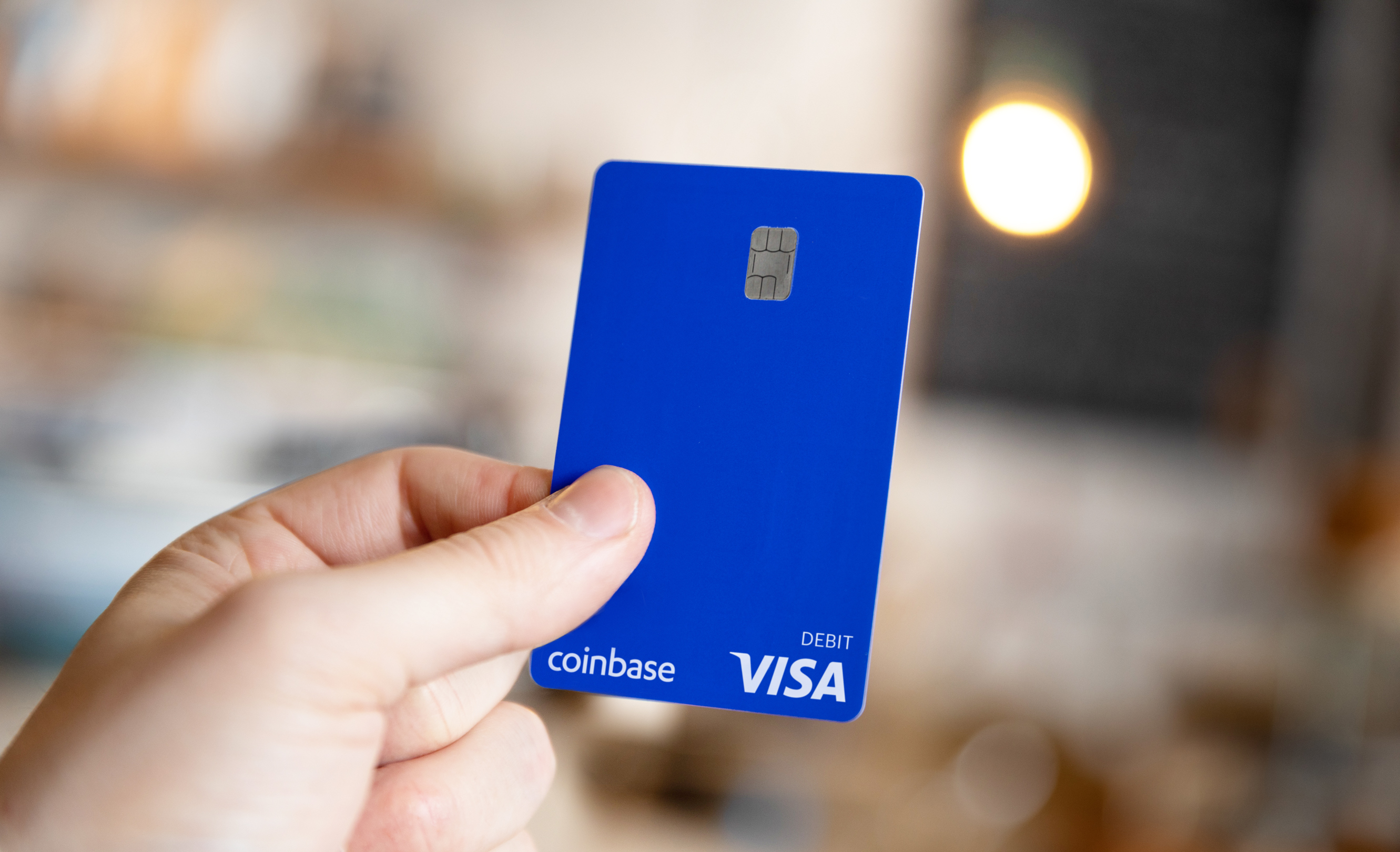
It is a Visa prepaid debit card issued by Pathward, N.A. and powered by Marqeta. Eligible Coinbase users can spend USD, USDC, or supported crypto at any Visa merchant worldwide. When you choose to pay with crypto, Coinbase automatically converts it to US dollars at the moment of purchase. You can also use the card at ATMs to withdraw cash.
The card works through a virtual version, which you get instantly on approval, and a physical card that ships to your address within two to three weeks.
What are the pros and cons of Coinbase Card?
|
Pros |
Cons |
|
Up to 4% crypto rewards (US, rotating) |
Conversion spread applies when spending non-stablecoin crypto |
|
No annual or foreign transaction fee |
Rewards limited to US users |
|
Instant virtual card on approval |
Apple Pay and Google Pay are US-only |
|
Apple Pay, Google Pay, and Samsung Pay support |
Daily spend and ATM caps |
|
No credit check or staking requirement |
Spending volatile crypto creates a taxable event in the US |
|
Freeze and unfreeze card instantly in-app |
What are the main features of Coinbase Card?
- Multi-asset spending. You can pay with USD, USDC, or any supported crypto directly from your Coinbase account. Before you pay, you pick the funding asset in the app and switch it anytime, even right before checkout.
- In-app card management. The Coinbase app lets you monitor transactions, view spending summaries, set or change your PIN, and freeze or unfreeze the card instantly. All of this is behind re-authentication for security.
- No annual or transaction fees. Coinbase charges no annual, monthly, or foreign transaction fees. There is also no Coinbase fee for ATM withdrawals, though the ATM operator may add its own surcharge.
- Security controls. The card uses two-factor authentication, real-time transaction alerts, instant card freezing, and zero-liability protection under Visa's network rules.
- Digital wallet support. US cardholders can add the virtual card to Apple Pay, Google Pay, or Samsung Pay for contactless payments before the physical card even arrives.
- 24/7 customer support. Coinbase offers a dedicated support center and customer care options for card-related issues.
Does Coinbase Card offer rewards?
Yes. US cardholders earn crypto back on every purchase, whether they pay with cash or crypto. You pick one reward asset in the Card tab of the Coinbase app, and the reward posts to your account after the transaction settles.
The current top reward rate is up to 4% back in crypto on rotating monthly offers. Past reward options have included Bitcoin, Ethereum, Dogecoin, and Algorand, though the available assets and rates change regularly. You can switch your reward asset anytime before your next purchase.
Unlike competing cards such as Crypto.com's Visa card, Coinbase does not require you to stake any token to access rewards. There is also no published cap on how much you can earn.
Cash withdrawals at ATMs do not earn rewards.
Coinbase Card rewards mechanics
|
Element |
Detail |
|
Base reward rate |
Variable by asset, shown in-app |
|
Top reward rate |
Up to 4% back (US, rotating offers) |
|
Reward currency |
User-selected crypto |
|
Payout timing |
Posts after transaction settlement |
|
Earnings cap |
No published cap |
|
Exclusions |
ATM withdrawals and cash-like transactions |
|
Staking requirement |
None |
Where is Coinbase Card accepted?
Coinbase Card is accepted anywhere that takes Visa debit. That covers tens of millions of merchants worldwide, including retail stores, restaurants, online platforms, and ATMs.
That said, certain merchant categories are blocked, typically those in high-risk or restricted sectors. If your card is declined, the most common reasons are insufficient funds, hitting your daily limit, a prohibited merchant category, or a temporary hold placed by merchants like gas stations or hotels that pre-authorize more than the final charge. Unused pre-authorization amounts are released once the payment settles.
Who can apply for Coinbase Card?
Coinbase Card is available to verified Coinbase users who are 18 or older and live in a supported region. A government-issued ID is required for identity verification. There is no credit check since it is a prepaid debit card, not a credit product.
Supported regions:
-
United States: All 49 states except Hawaii
-
United Kingdom
-
EEA countries: Austria, Belgium, Bulgaria, Croatia, Cyprus, Czech Republic, Denmark, Estonia, Finland, France, Germany, Greece, Hungary, Iceland, Ireland, Italy, Latvia, Liechtenstein, Lithuania, Luxembourg, Malta, Netherlands, Norway, Poland, Portugal, Romania, Slovakia, Slovenia, Spain, Sweden
Availability can change, so always check Coinbase's official support page for the current list.
How to apply for Coinbase Card and get started
For US users:
-
Sign in to Coinbase.com or open the Coinbase mobile app.
-
Go to the Card section.
-
Follow the prompts to apply, verify your address, and agree to the legal disclosures.
-
Choose your reward currency when prompted.
-
Use the virtual card immediately or order a physical card.
-
Set your PIN in the Card section.
-
Add to Apple Pay or Google Pay if you want mobile wallet payments.
For UK and EU users:
-
Open the Coinbase mobile app.
-
Select the Card section and follow the prompts.
-
Verify your address and agree to the disclosures.
-
Use the virtual card immediately or order a physical card.
-
Set your PIN in the Card section.
-
Note that Apple Pay and Google Pay are not available outside the US. Use the physical card for contactless tap-to-pay.
Are there alternative cards like Coinbase Card?
A few options are worth comparing if Coinbase Card does not fit your needs.
- Crypto.com Visa Card. This card offers tiered rewards and travel perks like lounge access and subscription rebates. The catch is that higher tiers require staking Crypto.com's native token, CRO, which adds risk and complexity. A good pick if you want fixed tiers rather than rotating offers.
- Binance Card. Binance's Visa debit card is primarily available in Europe and Latin America. It converts crypto holdings to local fiat at checkout and offers cashback rewards to eligible users.
- Gemini Credit Card. Unlike the others, Gemini's offering is a credit card, not a debit card. Available to eligible US users, it earns flat crypto rewards across everyday spending categories with no conversion spread at checkout. Worth considering if you prefer a credit line and a predictable earn rate.
- BitPay Card. A straightforward US debit option without crypto rewards. Good if you want simple, predictable pricing and do not care about earning crypto back.
- Revolut. Wider global coverage than Coinbase with a familiar fintech experience. Better if international availability is your priority over crypto rewards.
Are there tax implications for Coinbase Card?
Yes, and this is something many Coinbase Card guides gloss over.
In the United States, using crypto to pay for purchases is treated as a taxable disposal by the IRS. Each time you spend Bitcoin, Ethereum, or another volatile crypto, you are effectively selling it. If the value of that asset has gone up since you acquired it, you have a capital gain to report. If it has gone down, you have a capital loss.
The gain or loss is calculated based on the difference between what you paid for the crypto (your cost basis) and its fair market value at the time you spend it.
Spending USD or USDC avoids this entirely since there is no asset disposal involved. If you want to use Coinbase Card without creating tax events on every transaction, sticking to USD or USDC is the simpler path.
For UK and EU users, the rules differ by country, but many jurisdictions treat crypto payments similarly. Always check your local tax authority's guidance.
If you are tracking Coinbase Card transactions alongside other crypto activity, Blockstats integrates directly with Coinbase to import your transaction history automatically. It calculates your gains and losses and generates IRS-ready tax forms, saving you from piecing it together manually.
Read next: How to report your Coinbase taxes
Who is Coinbase Card for?
Coinbase Card suits existing Coinbase users who want a straightforward, no-fee debit card for everyday spending and the option to earn crypto rewards on top.
It works best if you plan to spend USD or USDC most of the time, since that avoids both the conversion spread and the tax complication that comes with spending volatile crypto. Frequent travelers will appreciate the lack of foreign transaction fees.
If you need very high daily spending limits, prefer a credit line, or live outside the US, UK, or EEA, another card may serve you better. And if rotating reward rates feels unpredictable, a card with a flat, fixed cashback schedule might be a more comfortable fit.
Final verdict
Coinbase Card is a solid, no-fuss debit card for existing Coinbase users. The zero annual fee, instant virtual card, and rotating crypto rewards make it easy to recommend for casual, everyday spending, especially when you stick to USD or USDC.
The trade-offs are real, though. Spending non-stablecoin crypto triggers a taxable event and a conversion spread, which chips away at the value of any rewards you earn. Rewards and Apple Pay support are currently US-only, and the daily limits may be tight for larger purchases.
For most Coinbase users who want a simple way to spend and earn crypto back on daily purchases, it gets the job done without complicating your finances, as long as you keep the tax side of things in order.
Blockstats integrates with Coinbase and Coinbase Wallet
If you use Coinbase to trade or spend crypto, Blockstats connects directly to your Coinbase account to pull in all your transactions automatically. It tracks your portfolio, calculates your gains and losses across every trade and card purchase, and generates clean, IRS-ready tax reports, so you are not scrambling at tax time.
You can also connect Coinbase Wallet alongside other exchanges and wallets for a single view of everything you hold and owe.
Get started with Blockstats for free
Frequently asked questions
How does a Coinbase card work?
Coinbase Card connects to your Coinbase account. When you pay, it converts your chosen crypto or USD to fiat instantly at the point of sale. The merchant receives a normal Visa payment. You can manage everything, including your funding asset and PIN, in the Coinbase app.
Why is my cash not withdrawing from Coinbase?
Common reasons include insufficient funds, hitting your daily ATM limit of $1,000, a blocked merchant or ATM category, or a security hold on your account. Check the Coinbase app for the exact decline reason and your remaining daily limit.
How do I add my Coinbase card to Apple Pay or Google Pay?
Open the Card tab in the Coinbase app and select the option to add to Apple Pay or Google Pay. Complete the device verification steps. This is only available to US cardholders. UK and EU users cannot add the card to mobile wallets.
How much does a Coinbase card cost?
Coinbase Card has no annual fee, no monthly fee, and no foreign transaction fee. Coinbase also charges no fee for ATM withdrawals, though the ATM operator may charge its own surcharge. A conversion spread applies when spending non-stablecoin crypto.
What does a Coinbase card do?
It lets you spend USD, USDC, or supported crypto anywhere Visa debit is accepted. Crypto is converted to fiat automatically at checkout. US users also earn rotating crypto rewards of up to 4% back on purchases.
What are the daily purchase and ATM withdrawal limits?
The daily spend cap is $2,500 per 24 hours. The daily ATM withdrawal cap is $1,000 per 24 hours. Your personal limits may vary based on identity verification and account history. Check the Card section of the app for your current limits.
Is the Coinbase card worth it?
For existing Coinbase users who spend USD or USDC regularly, yes. The no-fee structure and crypto rewards make it a useful everyday card. If you plan to spend a lot of volatile crypto, the conversion spread and tax implications reduce the value significantly.