Best Crypto Tax Software for DeFi, Staking & LP Rewards (2026)
Updated in March 2026 for current IRS guidance on DeFi activity.
Key takeaways
Traditional crypto tax tools work well for exchanges but struggle with DeFi transactions, especially LP tokens and yield farming.
Staking and protocol rewards are typically treated as ordinary income, requiring accurate, timestamped valuation
The new Form 1099-DA reporting requirement makes accurate cost basis tracking across platforms essential to avoid IRS discrepancies and potential audits
Most crypto tax tools handle basic exchange trades well. But hand them a Uniswap V3 LP position, multi-chain staking, or yield farming across protocols, and they break. If you've provided liquidity on Curve, staked ETH through Lido, or farmed yields across Layer 2s, you know the tax headache this creates. Specialized DeFi tax software solves this. This guide compares the best crypto tax software for DeFi, staking, and LP rewards in 2026.
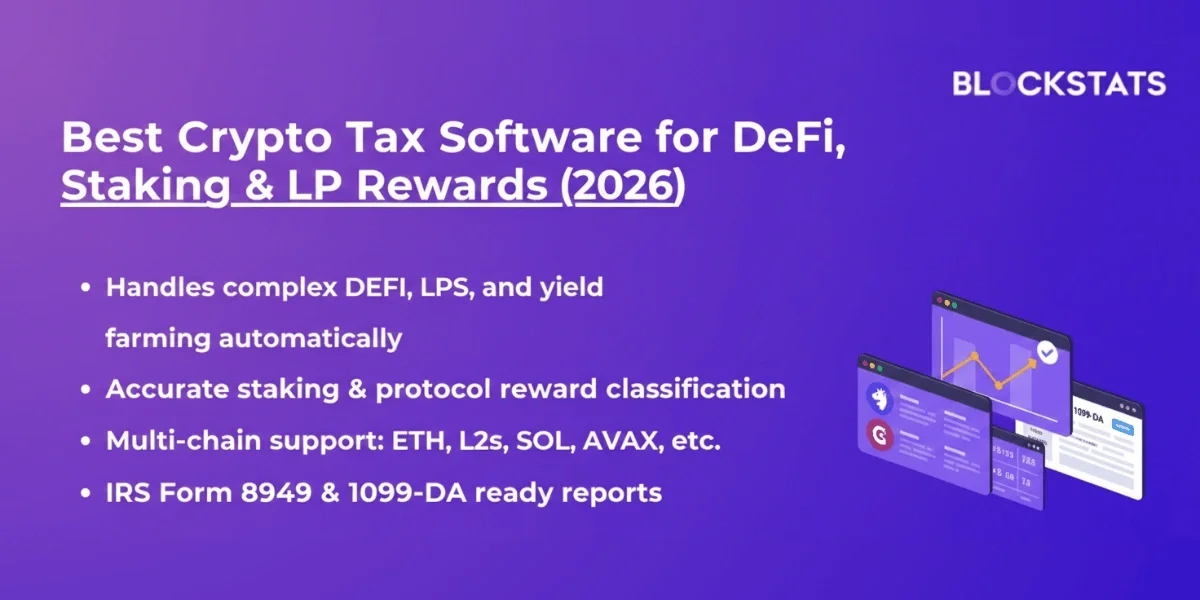
Best crypto tax software for DeFi, Staking, and LP Rewards
Here's how the leading platforms compare for DeFi tax reporting in 2026:
|
Software |
Best For |
DeFi Protocol Support |
Multi-Chain |
LP Token Tracking |
Staking Rewards |
Starting Price |
|
Blockstats |
Active DeFi users, yield farmers |
Excellent - Uniswap, Curve, Aave, Compound + 500+ protocols |
Excellent - All major chains + L2s |
Advanced - Handles V2/V3 positions |
Automatic classification |
$99/year |
|
CoinTracker |
Portfolio tracking, simple DeFi |
Basic - Major protocols only |
Good - Limited newer L2s |
Basic - Manual review often needed |
Supported with limitations |
$59/year |
|
ZenLedger |
CPA collaboration, U.S. focus |
Good - 20+ DeFi protocols |
Good - Main chains |
Good - Requires manual verification |
Good categorization |
$49/year |
|
Koinly |
Multi-chain coverage |
Good - 3000+ DeFi protocols |
Excellent - 170+ blockchains |
Good - Some manual tagging |
Auto-categorization |
$49/year |
|
SUMM |
Complex yield farming |
Excellent - Advanced DeFi reconciliation |
Excellent - Wide coverage |
Excellent - Sophisticated parsing |
Advanced income tracking |
$65/year |
Top DeFi tax software reviews
1. Blockstats
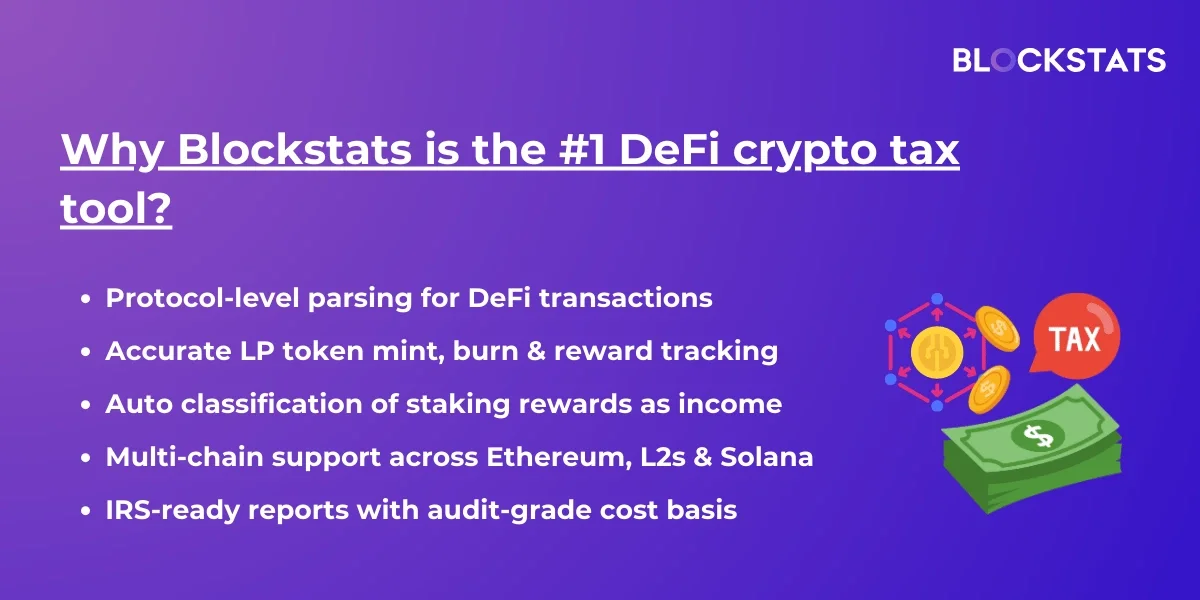
Blockstats is built specifically for modern on-chain activity, making it the best crypto tax software for DeFi traders with features purpose-built for decentralized finance. Unlike exchange-first tools, Blockstats analyzes transactions at the protocol and smart-contract level, which is critical for accurate DeFi tax reporting.
Blockstats pricing review: Free tier available, $99 (1,000 transactions), $149 (2,500 transactions), $199 (30,000 transactions) annually
Why is Blockstats the best DeFi crypto tax software in 2026?
Blockstats excels at accurately classifying staking rewards as income, tracking LP token minting and burning events, and accounting for reward emissions from protocols like Uniswap, Curve, and other DeFi platforms. Its minute-level historical pricing engine ensures defensible cost basis calculations, a key requirement for IRS audits.
The DeFi traders experience balances power with clarity. Wallet connections are fast, transaction classifications are reviewable, and reports export cleanly to Form 8949, Schedule D, and TurboTax. Blockstats also supports multi-chain DeFi activity across EVM and non-EVM networks, reducing the need for manual adjustments.
Pros:
-
DeFi-first architecture
-
Accurate LP and staking tracking
-
Strong IRS-ready reporting
-
Scales well for high-transaction users
-
AI tax optimization
Cons: Pricier than Koinly's entry tier. Its price starts at $49/ year for 100 transactions, whereas Blockstats pricing starts at $99/year for 1000 transactions.
Best for: Active DeFi users, yield farmers, multi-chain traders, and anyone with LP positions needing accurate reporting without manual corrections.
Winner: Best choice for active DeFi traders, yield farmers, and LPs.
2. CoinTracker
CoinTracker built its reputation as a portfolio tracker with tax features, not a DeFi-first solution. While it supports 500+ exchanges and smart contracts, users consistently report calculation errors in DeFi transactions. The platform handles basic staking and simple LPs but struggles with newer protocols, concentrated liquidity, and multi-step yield farming. Strong for exchange trading; requires frequent manual DeFi reconciliation.
CoinTracker pricing review: Free (25 transactions), from $59/year
Pros:
-
Excellent portfolio tracking
-
Strong CEX integration
-
Beginner-friendly
Cons: Users report frequent DeFi errors and limited new L2 support.
Best for: CEX traders with occasional DeFi who prioritize portfolio visualization.
3. ZenLedger
ZenLedger differentiates through professional tax support and CPA collaboration features. Supports DeFi protocols like Aave, Compound, Uniswap, Curve, etc but requires Premium/Platinum plans of $149+ for full DeFi access. Functional rather than exceptional DeFi tracking is good for basic activity, challenges with complex yield farming. Strong audit defense and full-service tax prep available.
ZenLedger pricing review: $49-$149/year software, $995+ CPA-prepared
Pros:
-
CPA access, audit support
-
U.S. forms, tax prep service
-
Good customer support
Cons: DeFi is locked in higher tiers, as well as offers less sophisticated reconciliation
Best for: U.S. users working with CPAs, moderate DeFi activity.
4. Koinly
Koinly offers broad blockchain coverage and supports many wallets and exchanges globally. For users interacting with multiple chains, this breadth is appealing.
The limitation lies in depth. While Koinly tracks DeFi transactions, LP token handling, and reward classification can lack precision. Users with heavy yield farming activity often need adjustments before filing.
Koinly pricing review: $49-$279/year
Pros:
-
Multi-chain support
-
International compliance and coverage
-
Competitive pricing with other tax calculators
Cons: High-volume trades report token pricing gaps, which need manual review.
Best for: Users with diversified multi-chain exposure but moderate DeFi complexity.
5. SUMM
SUMM has made meaningful progress in DeFi tracking and handles yield farming better than most tools. It supports protocol rewards and LP activity with reasonable accuracy.
The trade-off is usability. Reports can be harder to audit, and the interface is less intuitive for non-technical users. For advanced DeFi participants, accuracy may outweigh simplicity.
SUMM pricing review: $65-$3,499/year
Pros:
-
Superior complex DeFi reconciliation
-
NFT support
-
Wrapped token handling,
Cons: Higher pricing compared to top DeFi tax calculators like Blockstats.
Best for: Technically advanced users managing complex yield strategies.
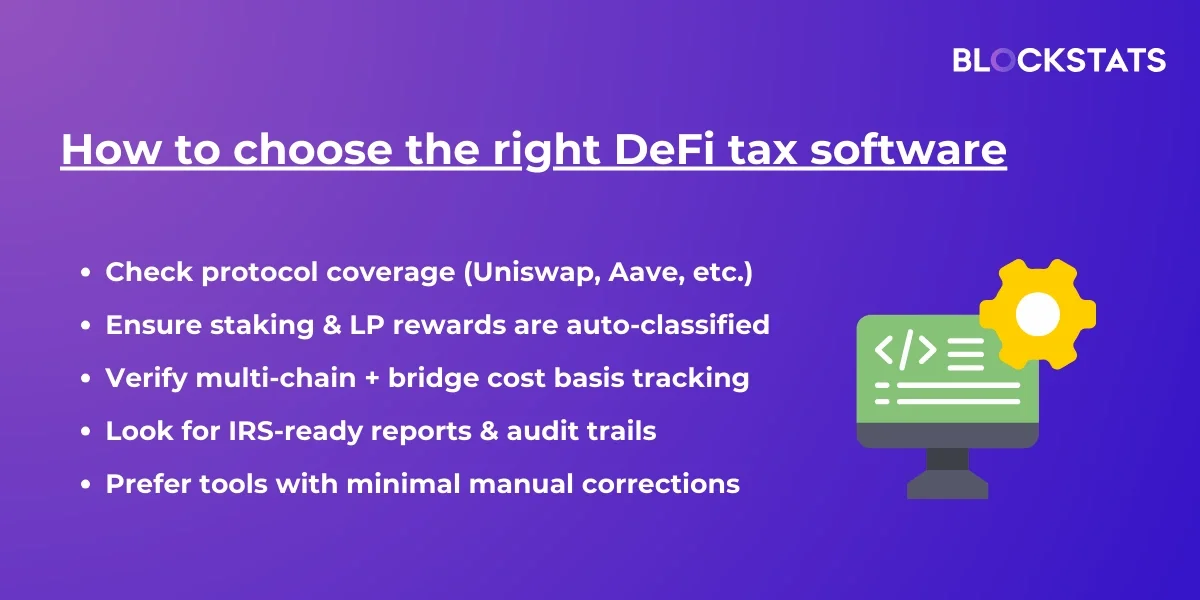
What key features to look for in DeFi Tax software
Protocol-level DeFi parsing
Software must understand that depositing USDC to Compound creates a lending position, not a taxable swap. Blockstats maintains a database of protocol mechanics. When it sees Compound interactions, it knows the transaction type and proper tax treatment. Look for explicitly listed supported protocols, not vague "DeFi support" claims.
Accurate staking & validator reward classification
Staking income must be timestamped and valued correctly as income, not capital gains. Errors here are common and risky.
LP tokens, fees, and reward emissions
Liquidity pools generate fees and rewards that compound over time. Proper tracking requires understanding mint, burn, and claim events. DeFi tax software like Blockstats tracks and categorizes correctly, eliminating hundreds of manual tags.
Multi-chain DeFi coverage
Serious DeFi users operate across Ethereum, Layer 2s such as Arbitrum, Optimism, Base, Solana, and alternative L1s. Software must support all relevant chains with automatic imports and maintain cost basis continuity across bridges.
Export formats and tax form generation
After calculating correctly, you need IRS-compliant Form 8949, Schedule D, Schedule 1, and TurboTax integration. The best crypto tax software for DeFi in 2026 generates all forms automatically with audit-ready transaction records.
How to get started with the DeFi tax calculator in 2026
- Sign up on Blockstats: Sign up on Blockstats for free
- Connect Wallets: Add addresses for every blockchain, hardware wallets, and exchanges you use.
- Review Transactions: Verify staking rewards are income, LP positions make sense, and bridges maintain cost basis.
- Generate Reports: Export IRS forms like 8949, Schedule D, or integrate with TurboTax. File your tax or share comprehensive reports with your CPA.
Verdict – Best crypto tax software for DeFi in 2026
For active DeFi users, yield farmers, and liquidity providers, Blockstats delivers the best combination of features. Protocol-level understanding, a free crypto portfolio tracker with tax reporting and AI optimization, solves problems competitors can't.
At $99/year with 1000 transactions, it beats competitors like CoinTracker's price with dramatically better DeFi support. With 2026's Form 1099-DA cross-referencing, accuracy matters more than ever. Choose purpose-built DeFi tax software.
If you’re earning yield on-chain, connect your wallet.
FAQs – DeFi crypto tax software
Is Blockstats better for DeFi than Koinly?
Yes, for high-volume DeFi traders, Blockstats is better than Koinly and other DeFi calculators. Blockstats provides superior protocol support, more accurate pricing for obscure tokens, and AI features for DeFi complexity. Koinly offers broader multi-chain support and international forms, but requires more manual review for complex DeFi transactions.
Do I need to report every DeFi transaction?
In the U.S., taxable events like staking income, rewards, and disposals must be reported, even if they occur on-chain. Every swap, stake, liquidity provision, withdrawal, and reward constitutes a potential taxable event. The IRS requires reporting all disposals on Form 8949 and all income from staking/farming on Schedule 1.
Can Blockstats track LP rewards automatically?
Yes. Blockstats automatically identifies liquidity pool positions across major protocols, including Uniswap, Curve, Balancer, and SushiSwap. It tracks fee and reward distributions and categorizes each correctly for tax purposes. The platform handles both simple LP positions and concentrated liquidity strategies.
How does Blockstats handle staking income?
Blockstats automatically categorizes staking rewards as ordinary income upon receipt, valued at fair market value. This establishes a proper cost basis for capital gains calculations when you eventually sell staked rewards.
Can Blockstats track DeFi across multiple chains?
Yes. Blockstats supports DeFi activity across Ethereum, all major Layer 2s (Arbitrum, Optimism, Base, Polygon), Solana, Avalanche, BNB Chain, and other networks, with automatic import via wallet address. The platform maintains cost basis continuity across bridges and cross-chain protocols.