How Blockstats Uses AI to Classify Crypto, DeFi, and NFT Transactions
March 2026 — Updated to reflect current IRS guidance and crypto transactions reporting standards.
Key takeaways
Blockstats uses AI-powered transaction intent recognition.
Static rule-based systems cannot scale with modern DeFi and NFT complexity.
Multi-step DeFi workflows are interpreted as complete lifecycles rather than isolated events.
Cross-chain bridge transactions maintain cost basis and holding period continuity.
Accurate AI-driven classification supports defensible Form 8949, Schedule D, and Schedule 1 reporting.
What once involved a handful of exchange trades now includes decentralized wallets, liquidity pools, NFT marketplaces, and multiple Layer 2 networks. Traditional rule-based crypto tax software struggles to keep up with this complexity.
Blockstats approaches transaction classification differently. Instead of relying purely on predefined rules, it uses AI-driven intent recognition to understand what actually happened in each interaction. In this guide, we’ll explain how that system works, why it matters for IRS reporting in 2026, and how AI-powered classification creates more reliable crypto tax outcomes.
Why accurate transaction classification matters for crypto taxes in 2026?
Every taxable crypto disposal must be reported on Form 8949. Those totals flow into Schedule D. Ordinary income events, such as staking rewards or airdrops, are generally reported on Schedule 1 under current IRS guidance.
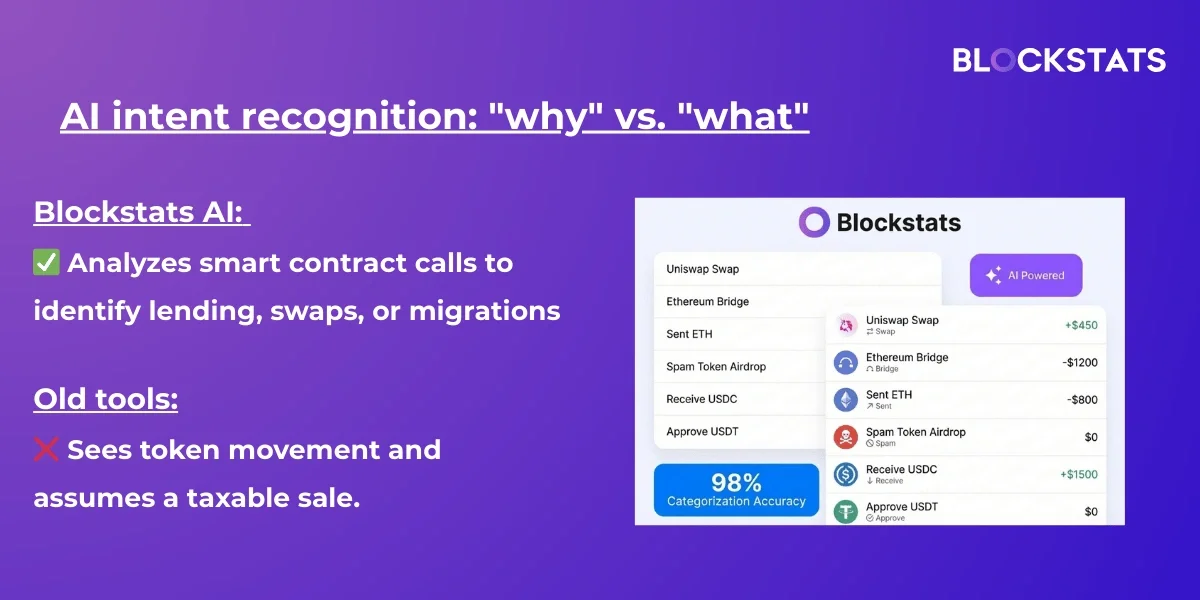
If a non-taxable action is misclassified as a sale, it creates phantom gains. That inflates taxable income and distorts your holding period calculations.
In 2026, tax authorities like the IRS want transparent and clear reporting with forms like 1099-DA. For US traders, especially those active across multiple chains, classification accuracy is no longer optional.
Why can't static rules handle modern crypto transactions?
Most crypto tax software started with an easy approach. If a transaction matched a known pattern, it was assigned a predefined category.
For example, if ETH left your wallet and USDC arrived, the software might classify that as a taxable trade.
This approach works well in structured exchange environments. Centralized platforms produce standardized transaction data, and trades follow predictable formats.
Decentralized finance operates differently.
-
Liquidity provision involves token approvals, deposits, LP token minting, and fee accrual.
-
Lending protocols issue interest-bearing tokens. Yield aggregators automate multi-step strategies behind the scenes.
-
NFT marketplaces embed royalties directly into transaction flows.
In these environments, token movement alone doesn’t tell the full story.
AI-driven systems attempt to move beyond simple pattern matching. Rather than asking only “what moved?”, they evaluate why it moved.
How Blockstats AI classifies Crypto, DeFi, and NFT transactions
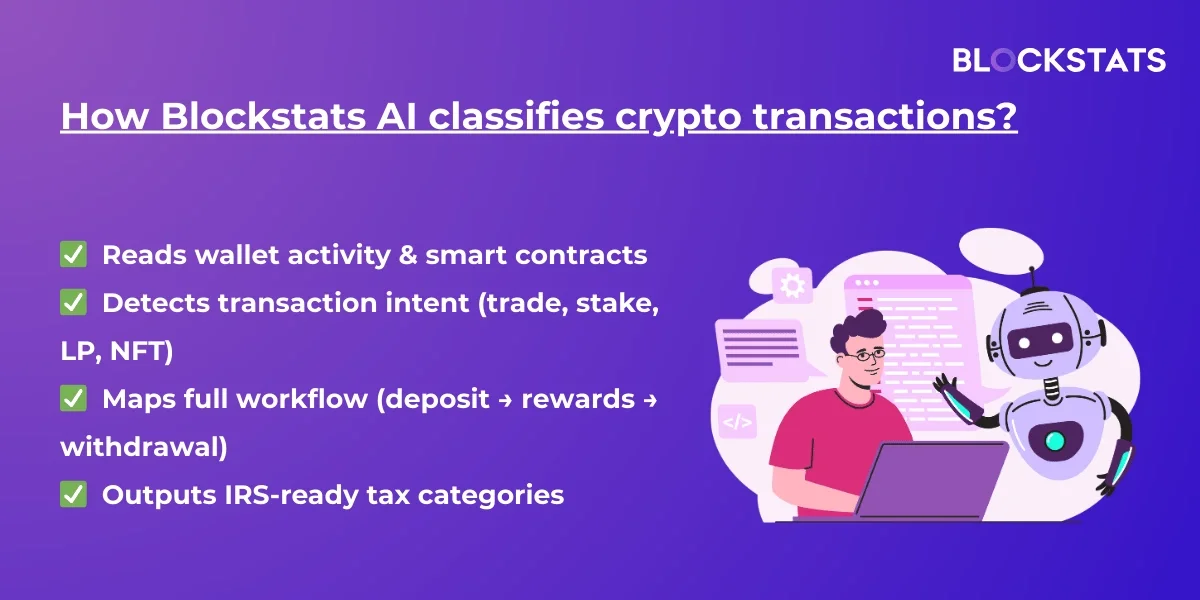
At the core of Blockstats is an intent-based classification engine designed to interpret on-chain activity in context.
Transaction intent recognition
Instead of asking only “what tokens moved?”, Blockstats analyzes smart contract addresses, function calls executed, event logs emitted, gas usage patterns, and timestamp sequences
Example: Depositing ETH into Aave and swapping ETH for USDC on Uniswap may both involve ETH leaving your wallet. But the intent differs:
Aave deposit - creates a lending position which is a non-taxable deposit)
Uniswap swap - taxable disposal
Protocol fingerprinting across chains
Each DeFi protocol has recognizable structural patterns. These include unique contract architectures, event signatures, and token minting behaviors.
Blockstats builds and continuously updates a protocol intelligence database across Ethereum, Arbitrum, Base, Polygon, and other supported chains.
This allows the system to recognize the same protocol logic across different networks without treating each deployment as unrelated. This level of continuity is one reason many DeFi users consider Blockstats one of the best crypto tax software solutions for multi-chain portfolios.
Contextual multi-step workflow analysis
DeFi rarely happens in a single transaction.
A typical liquidity strategy might involve approving a token, depositing into a pool, receiving an LP token, staking that LP token in a gauge, claiming rewards, and later withdrawing.
Blockstats AI evaluates sequences holistically. It recognizes that these steps form a single liquidity provision lifecycle, not unrelated taxable events.
This contextual analysis reduces manual review and prevents over-reporting of gains.
AI classification for NFT transactions
NFT tax reporting presents a different set of challenges.
A single NFT transaction may include marketplace fees, royalty payments, bundled assets, and varying sale structures. Gas fees from batch mints must be allocated proportionally across multiple tokens.
Blockstats evaluates marketplace-specific mechanics to determine whether an interaction represents:
-
A primary mint
-
A secondary sale
-
Royalty income
-
A simple transfer
By analyzing transaction context and marketplace patterns, the system separates capital gains from ordinary income where applicable.
Machine learning Infrastructure for the classification
Blockstats uses supervised learning models, trained on categorized transaction data from exchanges and protocols, to classify transaction types (trading, staking, etc.).
Experts initially label transactions, and the model learns the correlating features. Natural language processing helps interpret new smart contract functions, inferring actions like staking, even without explicit coding
The system assigns a confidence score. The low-score, novel transactions are flagged for human review. User corrections are used to improve the model's accuracy continuously.
Check out: Free crypto profit calculator →
How AI classifies a transaction with a real-world example
To see how this works in practice, consider a Curve liquidity strategy.
First, a user deposits USDC into a Curve pool.
The AI identifies the Curve contract signature and classifies the interaction as a non-taxable deposit, creating an LP position.
Next, the user receives a Curve LP token.
The system links the mint event to the original deposit and establishes the cost basis accordingly.
The user then stakes the LP token in a gauge contract.
This is recognized as a non-taxable staking action.
When CRV rewards are claimed
The system identifies the reward event and records ordinary income at fair market value upon receipt.
Finally, when the user withdraws liquidity
Blockstats calculates capital gains or losses based on the original deposit basis plus accrued fees.
AI vs rule-based systems: At a glance
|
Capability |
Rule-Based Tools |
Blockstats AI |
|
New protocol support |
Manual updates required |
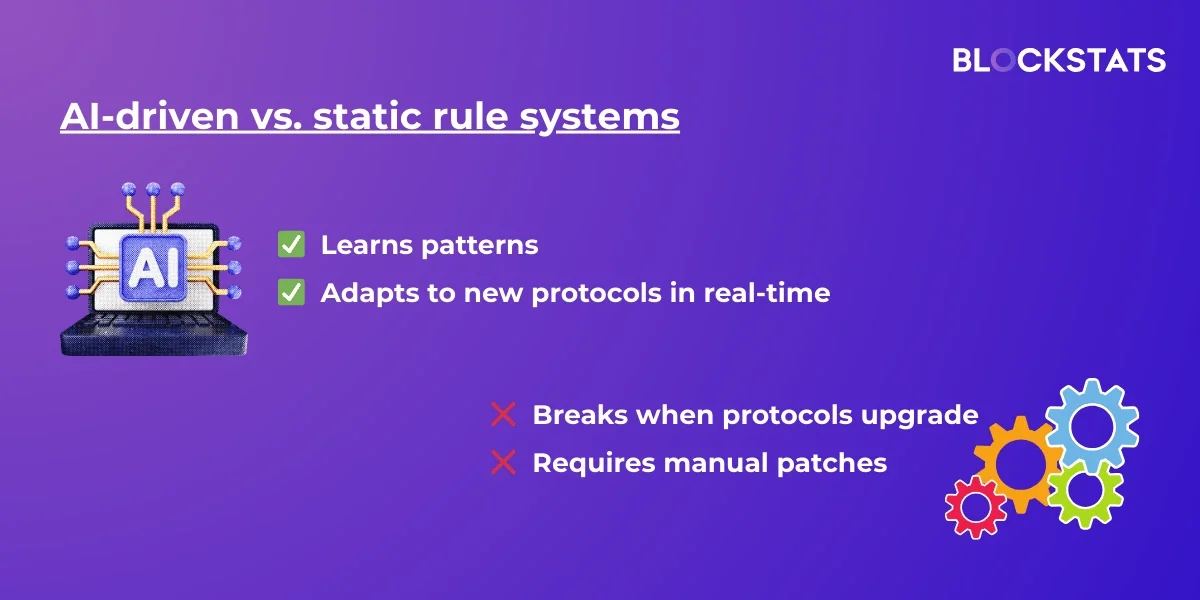
Learns from similar patterns |
|
Multi-step workflows |
Categorized independently |
Context-aware sequence analysis |
|
NFT marketplace variation |
Hard-coded logic |
Adaptive marketplace recognition |
|
Cross-chain recognition |
Separate per-chain rules |
Chain-agnostic protocol detection |
|
Protocol upgrades |
May break until patched |
Pattern-based resilience |
Why classification matters for your tax return
Traders and investors benefit from the consistent application of FIFO, LIFO, or HIFO methods across thousands of transactions.
-
Accurate AI classification leads to accurate Form 8949, Schedule D, Schedule 1
-
Reduces manual review time from days to minutes
-
Defensible to IRS: transaction categorization based on protocol mechanics, not guesswork
Check out: Free crypto tax calculator →
Conclusion
Crypto activity in 2026 is defined by complexity. Multi-chain portfolios, automated yield strategies, NFT marketplaces, and evolving IRS reporting requirements create a landscape that static rule systems were not designed to handle.
AI-powered transaction classification is the infrastructure for modern crypto tax reporting. By analyzing transaction intent, contextual workflows, and protocol mechanics, Blockstats provides a scalable approach to classifying crypto, DeFi, and NFT activity with greater consistency.
If you’d like to see how your transactions are categorized, you can connect your wallets and generate a report directly within Blockstats.
See how Blockstats AI classifies your transactions
Frequently asked questions
How does Blockstats AI know which transactions are taxable?
Blockstats AI analyzes smart contract interactions, function calls, token flows, and transaction sequences to determine economic intent. Taxable events are identified based on IRS guidance for disposals, income receipts, and capital gains rules.
Can AI misclassify transactions?
While highly accurate, low-confidence transactions are flagged for review. Users can adjust classifications if necessary.
Does Blockstats support new DeFi protocols?
The system uses pattern recognition and transfer learning to adapt to new protocols quickly. This reduces reliance on manual rule updates.
Is AI-based classification suitable for IRS reporting?
Yes. Classifications are based on protocol mechanics and documented tax treatment guidelines, helping maintain consistency with Form 8949 and Schedule D requirements.
Can users override AI classifications?
Yes. Users retain full control and can edit transaction categories when additional context is available.